



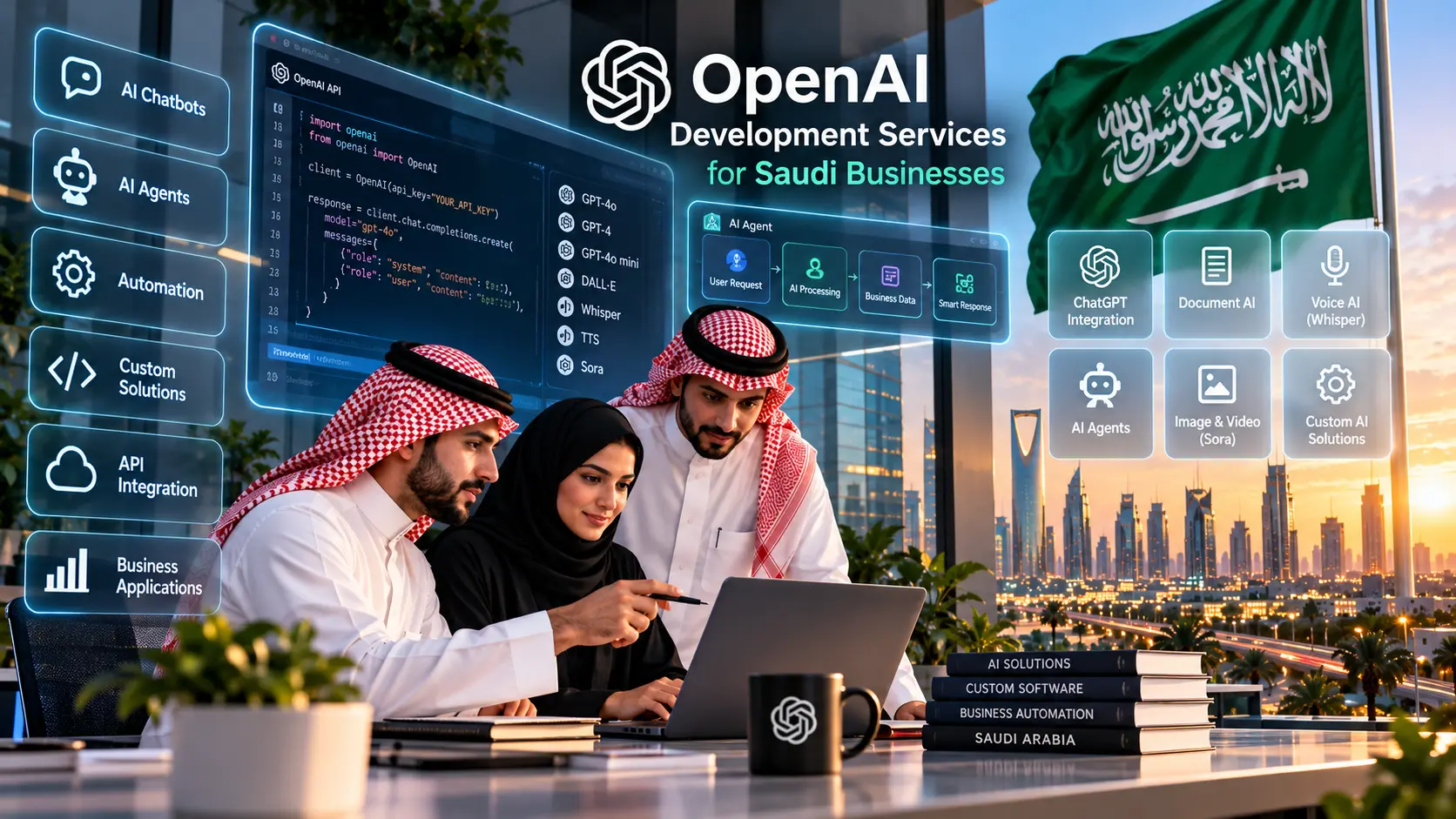
Artificial intelligence is moving from experimentation into everyday business operations. With OpenAI development services, companies can integrate AI into websites, mobile applications, internal systems, customer support platforms, document workflows, and business automation.
OpenAI provides developer tools that can be integrated into applications through its API platform. Its current developer ecosystem includes the Responses API, Agents SDK, Agents API, tools such as web and file search, and capabilities for building agentic applications. OpenAI Developers
For businesses in Saudi Arabia, the opportunity is not simply to add a chatbot. The real value comes from connecting AI with business data, existing software, workflows, and customer experiences.
Key Takeaways
- OpenAI development can be integrated into websites, applications, and business systems.
- OpenAI APIs allow developers to build AI-powered functionality into custom software.
- AI agents can use tools, maintain context, and complete multi-step tasks.
- Custom development is important when AI needs to work with a company’s existing systems.
- Saudi businesses can use AI for customer service, document processing, knowledge search, automation, and internal productivity.
- A successful AI implementation requires more than choosing a model; architecture, security, integrations, testing, and monitoring also matter.
- OpenAI API usage is separate from a ChatGPT subscription and is billed according to API usage and the selected models. OpenAI Developers
What Is OpenAI Development?
OpenAI development refers to building applications and business solutions that use OpenAI models and developer tools through APIs and software integrations.
Instead of using AI only through a consumer-facing chat interface, developers can connect AI capabilities directly to a company’s software.
For example:
Customer → Website → AI Assistant → Business System → Response
An AI solution could potentially:
- Answer customer questions
- Search company documents
- Summarize information
- Extract information from documents
- Generate business content
- Assist employees
- Classify customer requests
- Connect users with internal systems
- Support multi-step business workflows
The exact functionality depends on the business requirements and the APIs, models, tools, and architecture selected for the project.
What Are OpenAI Development Services?
OpenAI development services involve designing and developing software that uses OpenAI technologies to solve a specific business problem.
These services may include:
AI Chatbots
A business can integrate an AI assistant into its website, application, or customer portal.
Instead of answering only predefined questions, the assistant can be connected to approved business information and workflows.
AI Knowledge Assistants
Companies with large amounts of internal information can build systems that help employees find and understand relevant information.
For example:
Employee question → Knowledge search → Relevant information → AI-generated answer
AI Document Processing
AI can be incorporated into workflows that involve documents, forms, reports, or other business information.
AI Agents
OpenAI’s current developer platform supports agentic applications. Agents can use tools, work across multiple steps, and maintain context during workflows. OpenAI Developers
AI-Powered Applications
AI can become one component of a larger custom application rather than being the entire product.
For example:
CRM + AI
ERP + AI
POS + AI
Mobile App + AI
Customer Portal + AI
This approach can make AI more useful because it becomes part of an existing business process.
OpenAI API Platform vs ChatGPT
One common source of confusion is the difference between using ChatGPT and building software with OpenAI’s developer platform.
ChatGPT
ChatGPT is designed for people to interact with AI through a ready-made product experience.
OpenAI API Platform
The API platform is designed for developers who want to integrate AI capabilities into their own applications and systems.
This means a company could build an AI feature directly inside its:
- Website
- Mobile application
- CRM
- ERP
- Customer portal
- Internal software
- Ecommerce platform
- Business automation system
API usage is billed separately according to the models and usage involved. OpenAI Developers
Therefore, an OpenAI subscription and API-based application development should not be treated as the same thing.
OpenAI Agents and Modern AI Applications
AI development is moving beyond simple question-and-answer chatbots.
OpenAI’s current developer documentation includes several approaches for building agentic systems, including the Agents SDK, Agents API, and Responses API. OpenAI Developers
The Agents SDK allows developers to build agents within their own applications and control tools, workflows, state, and orchestration. OpenAI Developers
An agent could be designed around a workflow such as:
Customer request → Understand request → Search information → Use business tool → Complete action → Respond
For example, a company could develop an internal support agent that:
- Receives an employee request.
- Searches approved company information.
- Identifies the relevant procedure.
- Provides an answer.
- Escalates the issue when human intervention is required.
This is significantly different from simply placing a chat box on a website.
How OpenAI Development Can Help Saudi Businesses?
Saudi businesses across Riyadh, Jeddah, Dammam, Al Khobar, and the Eastern Province can apply AI to many operational areas.
Customer Service
AI assistants can help answer common questions and guide customers toward relevant information.
Business Knowledge
Employees can interact with internal knowledge systems using natural language instead of manually searching through large amounts of information.
Document Workflows
AI can support workflows involving business documents, provided the system is properly designed, tested, and secured.
Sales and CRM
AI can help organize customer information, summarize interactions, assist sales teams, and support customer communication.
Ecommerce
AI can support product discovery, customer assistance, content generation, and other ecommerce workflows.
Business Automation
AI can be connected to existing systems so that certain tasks can be processed automatically.
OpenAI, Whisper, TTS and Multimodal Applications
OpenAI development is not limited to text-based applications.
Developers can build solutions involving different forms of user interaction, including voice and other modalities.
For example, a business could create:
Voice Input → AI Processing → Business Logic → Voice Response
This can be useful for customer-service applications, voice assistants, internal tools, and mobile applications.
The OpenAI developer ecosystem also includes tools and APIs for building voice and realtime experiences, alongside broader agent development capabilities. OpenAI Developers
For Saudi businesses, Arabic support and the actual language used by customers should be considered during design and testing rather than treated as an afterthought.
How OpenAI Development Works?
A professional AI implementation normally involves several stages.
1. Business Analysis
First, identify the actual business problem.
For example:
“Our customer-service team spends too much time answering repetitive questions.”
That is a better starting point than simply saying:
“We need AI.”
2. Solution Architecture
The development team determines how AI will interact with the existing technology environment.
This may involve:
- Website
- Mobile application
- CRM
- ERP
- Database
- APIs
- Document storage
- Authentication
- Business workflows
3. AI Integration
The appropriate OpenAI API capabilities and model are integrated into the application.
4. Knowledge and Data Layer
If the application needs company-specific information, the architecture should determine how that information is retrieved, controlled, and presented to the model.
5. Testing
The solution should be tested for:
- Accuracy
- Reliability
- Security
- Response quality
- Edge cases
- Performance
- Cost
6. Deployment and Monitoring
After launch, the system should be monitored and improved based on real usage.
What Makes a Good OpenAI Development Project?
Using an AI model alone does not guarantee a successful application.
A strong implementation considers:
Business Objective
What problem is the AI actually solving?
User Experience
How will customers or employees interact with the system?
Integration
Can the AI work with the company’s existing systems?
Data Quality
Does the application have access to reliable and relevant information?
Security
Which users can access which information?
Human Oversight
Which decisions should remain subject to human review?
Evaluation
How will the business measure whether the AI is performing correctly?
These factors become increasingly important as AI moves from experimentation into production systems.
OpenAI Development Services for Saudi Companies
Saudi businesses looking for OpenAI development services should consider local business requirements alongside the technical implementation.
A solution may need to support:
- Arabic and English users
- Mobile-first experiences
- Existing enterprise systems
- CRM and ERP integrations
- Business-specific workflows
- Customer portals
- Internal employee systems
- Data protection requirements
- Scalable architecture
- Ongoing maintenance
Businesses in Riyadh may need enterprise AI platforms, while SMEs in Dammam or Al Khobar may be looking for practical automation or customer-service applications.
The right solution depends on the business problem rather than the popularity of a particular AI tool.
How to Choose an OpenAI Development Company?
When evaluating an OpenAI developer or development company, look beyond the ability to create a basic chatbot.
1. Technical Experience
Ask about API integration, backend development, databases, authentication, cloud infrastructure, and application architecture.
2. AI Experience
The provider should understand prompts, tool calling, retrieval, evaluation, agents, and AI application design.
3. Business Understanding
The team should understand your actual workflow rather than simply adding AI to an existing interface.
4. Security
Discuss authentication, permissions, data handling, logging, and access controls.
5. Scalability
The solution should be designed with future users, integrations, and functionality in mind.
6. Post-Launch Support
AI applications need monitoring, testing, optimization, and updates as requirements evolve.
Safha Technologies’ Approach
Safha Technologies can support businesses looking to incorporate AI into their existing digital operations or develop new custom software solutions.
Depending on the project, the solution may combine:
- AI solutions
- Custom software
- Website development
- Mobile application development
- CRM
- Odoo ERP
- POS
- Business automation
- AI document management
- AI attendance
- UI/UX design
The objective should be to connect AI to a meaningful business workflow rather than using AI simply because it is available.
For example:
Customer → AI assistant → CRM → Business data → Automated response
or:
Employee → AI knowledge system → Company documents → Relevant answer
This type of integration can turn AI from a standalone feature into a useful part of the company’s digital infrastructure.
Conclusion
OpenAI development services can help Saudi businesses move beyond basic AI experimentation and build practical applications around their actual business processes.
From AI assistants and knowledge systems to document processing, CRM integration, automation, voice applications, and AI agents, the possibilities depend on the business problem and the technology architecture behind the solution.
For companies in Riyadh, Jeddah, Dammam, Al Khobar, and across Saudi Arabia, the most important question is not simply which AI model to use.
The better question is:
Where can AI create measurable value inside your business?
Once that question is answered, the right APIs, architecture, integrations, security controls, and development approach can be selected.
Build an AI Solution Around Your Business
Talk to Safha Technologies about your AI, software, automation, or application requirements.