


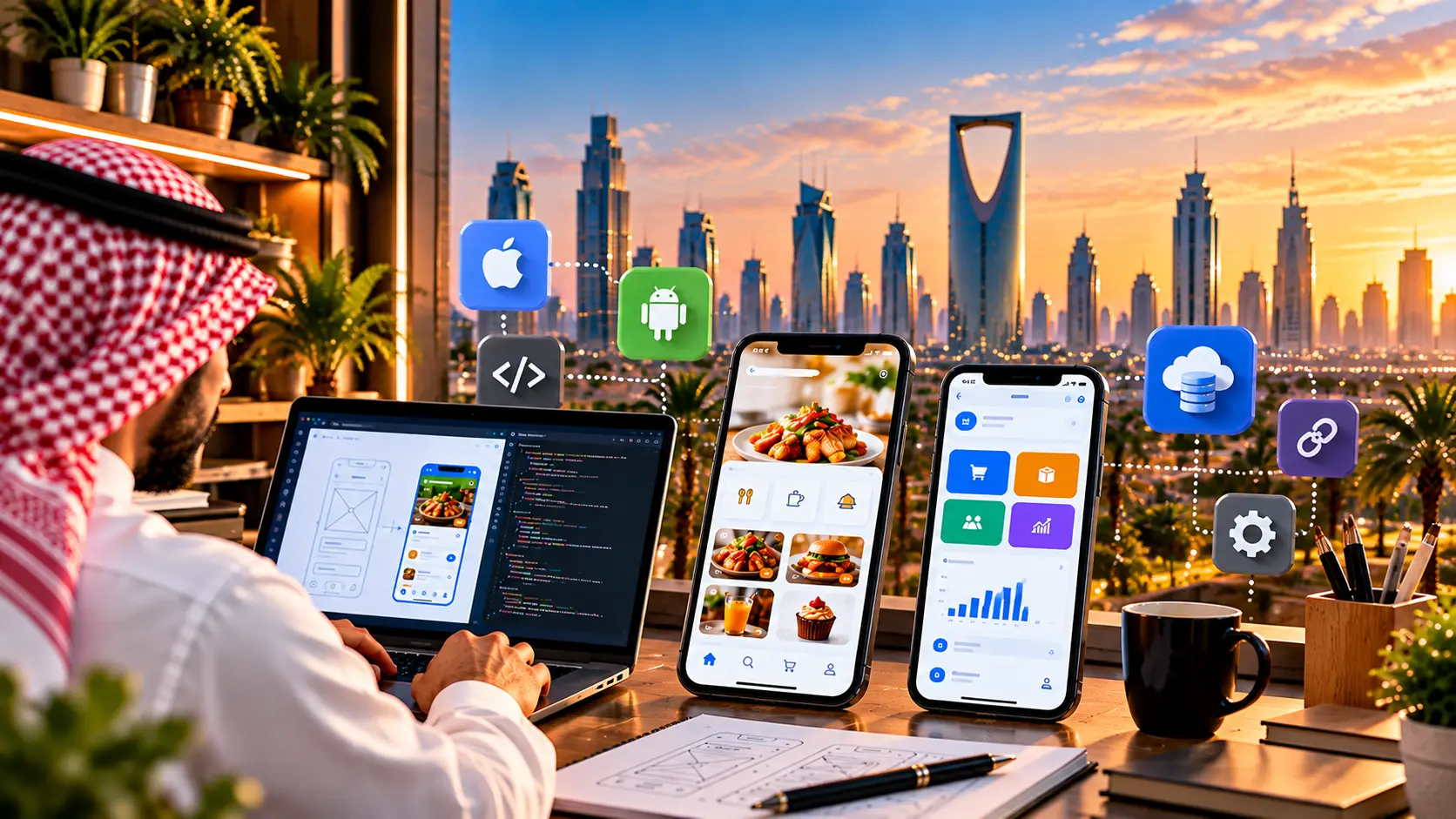
Introduction
Mobile applications have become an important digital channel for businesses that want to provide services, communicate with customers, manage operations, or create entirely new digital products. Mobile app development services cover much more than writing code—they include product strategy, user experience, interface design, backend systems, integrations, testing, security, deployment, and ongoing maintenance.
For businesses in Saudi Arabia, mobile applications can support customer-facing services, internal operations, e-commerce, bookings, education, healthcare, restaurants, logistics, finance, and many other use cases. Saudi Arabia’s digital transformation agenda continues to emphasize digital services, technology, and the development of the digital economy.
The Digital Government Authority has also reported strong development in Saudi Arabia’s electronic and mobile government services, including a 96% maturity score in the 2024 Government Electronic and Mobile Services Maturity Index.
Safha Technologies provides mobile application development alongside custom software, websites, UI/UX design, CRM, ERP, POS, AI solutions, and business automation.
Key Takeaways
- Mobile app development involves strategy, design, development, testing, deployment, and maintenance.
- Businesses can develop Android, iOS, or cross-platform applications depending on their requirements.
- Good mobile app design should make important actions simple and intuitive.
- Mobile applications can connect with CRM, ERP, POS, payment systems, websites, and other business platforms.
- Saudi businesses should consider Arabic and English support where relevant.
- Security and personal-data protection should be considered from the beginning of the project.
- A scalable architecture makes it easier to add users, features, and integrations later.
- Choosing a mobile app development company should involve evaluating both technical expertise and understanding of the business problem.
What Are Mobile App Development Services?
Mobile app development services involve planning, designing, developing, testing, launching, and maintaining applications for smartphones and tablets.
A complete mobile application project may include:
- Product strategy
- Business requirements analysis
- Mobile app design
- UI/UX design
- Android app development
- iOS app development
- Cross-platform development
- Backend development
- Database development
- API integration
- Payment integration
- Authentication
- Push notifications
- Analytics
- Testing
- App Store and Google Play deployment
- Maintenance and updates
The technology selected should depend on the application’s requirements rather than simply following a particular development trend.
Mobile App Design: Why Does It Matter?
A mobile application can have strong technical functionality and still provide a poor user experience if the interface is difficult to understand.
Mobile app design should consider:
Simple Navigation
Users should be able to find important functions without unnecessary steps.
Clear User Journeys
The application should guide users naturally from one action to the next.
Consistent Interface
Buttons, typography, spacing, icons, and visual elements should follow a consistent design system.
Fast Interaction
Frequently used actions should be easy and quick to complete.
Responsive Layouts
The interface should work across the supported screen sizes and devices.
Arabic and English Experience
For Saudi businesses serving bilingual audiences, the application may need both Arabic and English interfaces, including appropriate right-to-left support for Arabic.
Android App Development and Cross-Platform Development
Businesses have several options when building mobile applications.
Android App Development
Android applications can be developed specifically for Android devices and can be distributed through Google Play where applicable.
Android development can be suitable when the target audience or business requirements are heavily focused on Android users.
iOS App Development
Businesses targeting Apple users can develop applications for iPhone and iPad.
Cross-Platform Development
Cross-platform technologies can allow businesses to build applications for multiple platforms from a shared development approach.
The appropriate technology depends on:
- Required features
- Performance requirements
- Budget
- Development timeline
- Device capabilities
- Existing systems
- Future maintenance
- Team expertise
A professional development process should select the technology after understanding these requirements.
What Can a Business Build With a Mobile App?
Mobile applications can be used across many industries.
E-Commerce
Businesses can provide customers with:
- Product browsing
- Shopping carts
- Payments
- Orders
- Delivery tracking
- Customer accounts
- Notifications
Restaurants
A restaurant application can support:
- Online ordering
- Reservations
- Delivery
- Loyalty programs
- Menus
- Customer accounts
- Offers
- Branch information
Healthcare
Depending on the application and applicable requirements, mobile solutions can support:
- Appointment booking
- Patient communication
- Reminders
- Service information
- Administrative workflows
Education
Applications can support:
- Courses
- Lessons
- Student accounts
- Attendance
- Assessments
- Notifications
- Learning management
Logistics
Mobile applications can support:
- Delivery management
- Driver applications
- Order tracking
- Customer notifications
- Location-based workflows
- Operational reporting
Business and Enterprise
Internal applications can help employees manage:
- Tasks
- Approvals
- Attendance
- Documents
- Customers
- Sales
- Internal communication
- Business processes
How Does Mobile App Development Work?
A professional mobile application project generally follows several stages.
1. Requirements Analysis
The development team identifies:
- Target users
- Business objectives
- Required features
- User roles
- Integrations
- Technical requirements
2. Product Planning
The required features are organized into priorities.
For startups and new products, an initial minimum viable product can be defined before developing the complete platform.
3. UI/UX Design
The team creates user flows, wireframes, interface designs, and prototypes.
4. Development
Developers build the mobile application, backend, database, APIs, authentication, integrations, and required functionality.
5. Testing
The application should be tested for:
- Functionality
- Performance
- Security
- Compatibility
- Usability
- Different screen sizes
- Different operating systems
6. Deployment
The application is prepared for the relevant app stores and production environment.
7. Maintenance
After launch, applications require updates, bug fixes, security improvements, performance monitoring, and new features as business requirements evolve.
Mobile App Development Services for Saudi Businesses
Saudi Arabia’s digital transformation continues to create opportunities for businesses to develop digital platforms and mobile services. Vision 2030 identifies the development of the digital economy as a strategic objective, while government digital transformation initiatives emphasize digital platforms, products, services, integration, and data-driven operations. Saudi Vision 2030
For businesses in Riyadh, Jeddah, Dammam, Al Khobar, and the Eastern Province, mobile applications can support both customer-facing and internal business processes.
Depending on the project, Saudi businesses may require:
- Arabic and English interfaces
- Right-to-left Arabic design
- Secure user authentication
- Online payments
- Customer accounts
- Business integrations
- Location-based services
- Notifications
- CRM integration
- ERP integration
- POS integration
- Analytics
- Administrative dashboards
Businesses that process personal information should also consider applicable data-protection requirements. Saudi Arabia’s Personal Data Protection Law applies to processing personal data relating to individuals in the Kingdom, subject to its scope and provisions. Data Governance Platform
Mobile Apps and Business System Integration
A mobile application does not have to operate independently.
It can become a front-end channel connected to the company’s existing systems.
Mobile App + CRM
Customer information, leads, interactions, and service requests can be connected with CRM workflows.
Mobile App + ERP
Businesses can connect mobile applications with ERP systems for selected operations such as inventory, sales, approvals, or reporting.
Mobile App + POS
Restaurants and retailers can connect mobile applications with POS and order-management systems.
Mobile App + Website
The website and application can share relevant backend services, accounts, products, content, and business information.
Mobile App + AI
AI features can be incorporated for customer assistance, search, recommendations, document processing, or other business-specific requirements.
Benefits of Professional Mobile App Development
Better Customer Access
Customers can access services directly from their mobile devices.
Stronger Digital Experience
A dedicated application can provide a more focused experience than a general website when the use case requires it.
Business Automation
Applications can automate selected workflows and reduce manual communication.
Customer Engagement
Notifications, accounts, loyalty features, and personalized services can support ongoing customer interaction.
Data and Reporting
Applications can collect relevant operational information that can be connected with analytics and business systems.
Scalable Digital Products
A properly designed application can evolve as the business adds users, services, features, and integrations.
How to Choose a Mobile App Development Company?
When searching for mobile app developers, mobile app developers near me, or a professional development company, consider more than the quoted price.
Technical Experience
Review experience with:
- Android
- iOS
- Cross-platform development
- Backend development
- APIs
- Databases
- Cloud services
- Security
UI/UX Capability
The provider should be able to explain how the application’s user experience will be planned and tested.
Integration Experience
Ask how the application will connect with existing CRM, ERP, POS, payment, website, or internal systems.
Security
Discuss authentication, access control, data storage, encryption, API security, and appropriate data-protection practices.
Scalability
The architecture should account for future users, features, data, and integrations.
Post-Launch Support
Clarify how updates, bug fixes, maintenance, monitoring, and future development will be handled.
Mobile App Developer Freelancer vs Development Company
A freelancer may be suitable for a small, clearly defined project. However, larger business applications often require several disciplines, including:
- Product management
- UI/UX design
- Mobile development
- Backend development
- Quality assurance
- DevOps
- Security
- Ongoing maintenance
For larger applications, a development team can provide access to different technical capabilities under one project structure.
The appropriate choice depends on the project’s complexity, budget, timeline, and long-term support requirements.
Safha Technologies’ Approach to Mobile App Development
Safha Technologies develops customized mobile applications based on business requirements.
Our broader digital capabilities can connect mobile applications with:
- CRM
- Odoo ERP
- POS
- AI solutions
- Custom software
- Websites
- Business automation
- Dashboards
- API integrations
- UI/UX design
The process starts by understanding the business model, target users, required features, existing systems, and future goals.
The application is then planned around the required user journeys and designed before development begins.
For Saudi businesses, the solution can also be planned around Arabic and English experiences, appropriate right-to-left design, local operational requirements, and relevant data-protection considerations.
Mobile App Development for Riyadh, Jeddah, Dammam and Al Khobar
Businesses across Saudi Arabia can use mobile applications for different purposes.
Riyadh
Enterprise platforms, financial services, retail, healthcare, logistics, education, and customer-service applications.
Jeddah
Retail, hospitality, restaurants, tourism, logistics, e-commerce, and service applications.
Dammam and Eastern Province
Industrial, logistics, trading, manufacturing, healthcare, and business applications.
Al Khobar
Professional services, hospitality, retail, restaurants, real estate, and customer-facing digital services.
The technology should always be selected according to the business requirements rather than the location alone.
Conclusion
Mobile app development services can help businesses create dedicated digital experiences for customers, employees, partners, and internal operations.
A successful mobile application requires more than development alone. Product strategy, UI/UX, technical architecture, integrations, security, testing, deployment, and ongoing maintenance all contribute to the final product.
For businesses in Saudi Arabia, applications may also need Arabic and English experiences, integration with existing business systems, and appropriate consideration of data-protection requirements.
Safha Technologies helps businesses in Saudi Arabia develop mobile applications alongside CRM, ERP, POS, AI, custom software, websites, UI/UX, and business automation solutions.
Build Your Mobile Application With Safha Technologies
Have an idea for a mobile application or want to transform an existing business process into a mobile experience?
Discuss your requirements with Safha Technologies and explore a customized mobile app development solution.