




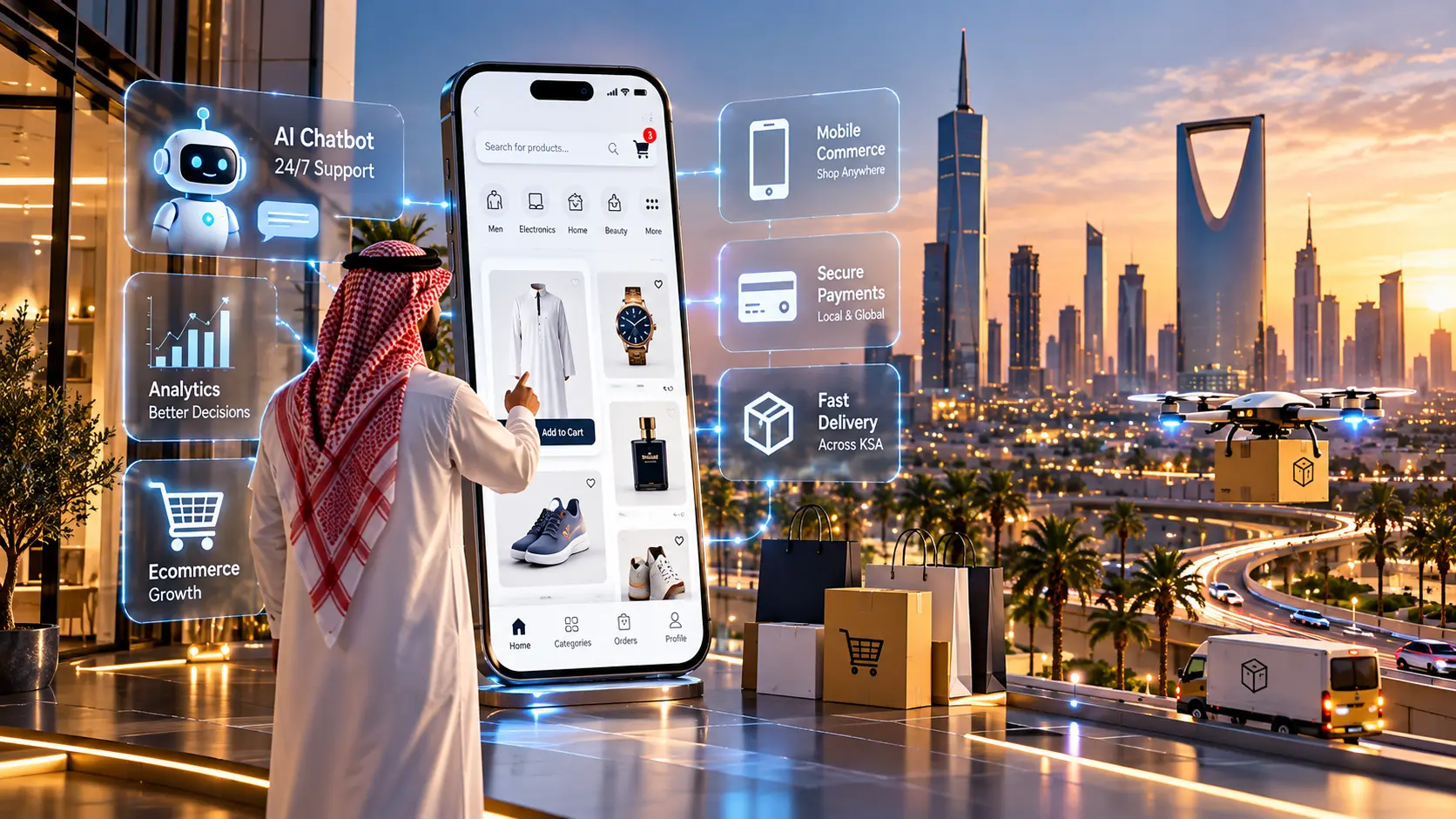
Ecommerce is no longer simply about selling products through an online store. Customers now expect fast experiences, convenient payments, personalized recommendations, quick support, and smooth delivery. This is why the future of ecommerce is moving toward smarter, more connected, and more customer-focused digital experiences.
For businesses in Saudi Arabia, from startups and SMEs to established retailers and enterprises in Riyadh, Jeddah, Dammam, Al Khobar, and the wider Eastern Province, choosing the right ecommerce solutions can make a major difference in how they attract customers, manage orders, and grow online.
Key Takeaways
- The future of ecommerce is becoming more personalized, automated, and data-driven.
- A successful ecommerce store needs more than attractive product pages.
- AI chatbots can improve customer support and product discovery.
- Ecommerce analytics help businesses understand customer behavior and sales performance.
- Mobile-first shopping experiences are increasingly important.
- Shopify and custom ecommerce platforms can serve different business requirements.
- Integrating ecommerce with CRM, POS, ERP, inventory, and payment systems can create a more connected operation.
- Saudi businesses should choose technology based on their customers, products, operations, and long-term goals.
What Is the Future of Ecommerce?
The future of ecommerce is about creating a shopping experience that is easier, faster, smarter, and more relevant to each customer.
Traditional ecommerce focused mainly on having an online store where customers could browse products and complete purchases.
Modern ecommerce goes further.
Businesses are now looking at:
- Artificial intelligence
- Personalized shopping experiences
- Ecommerce chatbots
- Mobile commerce
- Automated customer support
- Ecommerce analytics
- Smart product recommendations
- Digital payments
- Omnichannel shopping
- Automated inventory management
- Faster order processing
- Customer data and CRM integration
The goal is not simply to put products online. It is to create a connected digital business.
Why Ecommerce Solutions Matter for Saudi Businesses?
Saudi Arabia has a diverse and competitive digital business environment. Customers may discover a product through social media, search for it on Google, visit an ecommerce store from their phone, contact the business through WhatsApp, and then complete the purchase online.
This means businesses need their different digital touchpoints to work together.
For example, an ecommerce business in Riyadh may need to connect:
Website → Customer → Payment → Inventory → Order → Delivery → CRM → Analytics
When these systems operate separately, managing the business can become complicated.
Modern ecommerce development services can help businesses create a more connected experience.
For companies operating in Jeddah, Dammam, Al Khobar, Riyadh, or other Saudi cities, the right ecommerce setup should also consider Arabic content, mobile usability, local customer expectations, payment options, delivery workflows, and business operations.
Ecommerce Trends Shaping the Future
1. AI-Powered Ecommerce
Artificial intelligence is becoming increasingly useful in online commerce.
Businesses can use AI to support:
- Product recommendations
- Customer service
- Product search
- Content creation
- Customer segmentation
- Automated responses
- Sales analysis
An ecommerce chatbot can answer common customer questions, help visitors find products, and guide them through the buying process.
The best use of AI is not simply adding a chatbot to a website. It is using AI where it genuinely improves the customer experience or reduces repetitive work.
2. Personalized Shopping Experiences
Customers do not always want to see the same products or content.
Ecommerce platforms can use customer behavior and purchase history to create more relevant experiences.
For example, a customer who regularly purchases men’s clothing could receive recommendations based on previous purchases or browsing behavior.
Personalization can be applied to:
- Product recommendations
- Promotions
- Email campaigns
- Search results
- Homepage content
- Customer offers
Businesses should still use customer data responsibly and transparently.
3. Mobile Commerce
A large part of modern ecommerce activity happens through mobile devices.
That means an ecommerce website should be designed for smaller screens from the beginning rather than simply adapting a desktop website later.
A good mobile shopping experience should make it easy to:
- Browse products
- Search
- Compare products
- Add items to the cart
- Complete checkout
- Contact support
- Track an order
For Saudi businesses targeting customers across Riyadh, Jeddah, Dammam, and other cities, mobile usability should be a core part of the ecommerce strategy.
4. Ecommerce Analytics
Building an ecommerce store is only the beginning.
Businesses also need to understand what happens after visitors arrive.
Ecommerce analytics can help answer questions such as:
- Which products receive the most attention?
- Where are customers leaving the buying journey?
- Which marketing channels bring valuable visitors?
- Which products generate the most revenue?
- How many visitors become customers?
- Which campaigns generate sales?
These insights can help business owners make better decisions instead of relying only on assumptions.
Shopify vs Custom Ecommerce Development
There is no single ecommerce platform that is perfect for every business.
Shopify Ecommerce
Shopify can be a practical option for businesses that want to launch and manage an ecommerce store using an established platform.
It can be suitable for:
- Startups
- Growing retailers
- Product-based businesses
- Businesses that need to launch relatively quickly
Shopify ecommerce development services can include store customization, theme development, integrations, user experience improvements, and additional functionality.
Custom Ecommerce Development
Custom development may be more appropriate when a business requires functionality that does not fit easily into a standard platform.
For example:
- Complex product configuration
- Unique pricing rules
- Custom customer portals
- Advanced business workflows
- Multiple system integrations
- Specialized dashboards
- Custom inventory processes
The right choice depends on the business model, budget, technical requirements, and long-term plans.
How Modern Ecommerce Solutions Work?
A strong ecommerce ecosystem normally connects several parts of the business.
1. Customer Experience
The customer visits the website or application, searches for products, reviews information, and adds items to the cart.
2. Checkout and Payment
The customer completes checkout through the available payment methods.
3. Order Management
The order is recorded and sent to the relevant operational team.
4. Inventory
Stock levels are updated based on orders and inventory movements.
5. Fulfillment and Delivery
The order moves through the fulfillment and delivery process.
6. Customer Communication
Customers can receive relevant order updates and support.
7. Analytics
Business owners can review sales, customer behavior, products, and other performance information.
8. CRM and Business Systems
The ecommerce platform can potentially connect with CRM, POS, ERP, accounting, inventory, or other business systems.
This creates a more connected operation instead of treating the online store as a separate part of the business.
Benefits of Modern Ecommerce Solutions
A well-planned ecommerce ecosystem can help businesses:
Improve Customer Experience
Customers can browse, purchase, communicate, and track orders more easily.
Reduce Manual Work
Automated workflows can reduce repetitive administrative tasks.
Improve Business Visibility
Analytics and reporting provide better insight into sales and customer activity.
Connect Business Operations
Ecommerce can be connected with inventory, CRM, POS, ERP, and other systems.
Support Business Growth
A scalable ecommerce setup can support additional products, customers, and sales channels.
Create Better Marketing Decisions
Businesses can use customer and sales data to improve campaigns and product strategies.
How to Choose the Right Ecommerce Development Company?
Choosing an ecommerce development company should involve more than comparing prices.
Look for a partner that understands both technology and business.
Check Their Ecommerce Experience
Ask whether they have experience building ecommerce stores and digital commerce platforms.
Understand Their Development Approach
Find out whether they offer Shopify, custom development, integrations, mobile experiences, or other technologies relevant to your project.
Review UI/UX Capability
A visually attractive store should also be easy to navigate and purchase from.
Ask About Integrations
If you already use CRM, POS, ERP, accounting, inventory, or payment systems, discuss how they will connect with the ecommerce platform.
Consider Scalability
Your ecommerce platform should be able to support future products, customers, branches, and features.
Think Beyond Launch
Ask about maintenance, security, technical support, performance optimization, and future improvements.
Safha Technologies’ Approach
Safha Technologies approaches ecommerce projects by looking at the complete business requirement rather than only the storefront.
Depending on the project, Safha can support businesses with:
- Ecommerce website development
- Custom software development
- Shopify development
- UI/UX design
- Mobile application development
- CRM
- POS
- Odoo ERP
- AI solutions
- Business automation
- API integrations
- Website development
The objective is to create an ecommerce experience that works for both the customer and the business behind the store.
For a growing Saudi business, that may mean starting with an ecommerce store and later connecting it with inventory, CRM, POS, ERP, analytics, or automation systems.
The Future of Ecommerce in Saudi Arabia
The future of ecommerce will not be defined by one platform or one technology.
Instead, successful businesses are likely to focus on creating connected experiences across websites, mobile devices, social media, customer support, payments, fulfillment, and business systems.
AI, personalization, analytics, automation, and better mobile experiences will continue to influence how customers discover and purchase products.
For Saudi businesses, the opportunity is to choose ecommerce technology that fits their customers and operations today while leaving room for future growth.
Conclusion
The future of ecommerce is moving toward smarter technology, better customer experiences, stronger personalization, automation, and connected business systems.
Whether a business chooses Shopify, custom development, or a combination of different technologies, the important thing is to build an ecommerce ecosystem around real business requirements.
For businesses in Saudi Arabia, Riyadh, Jeddah, Dammam, Al Khobar, and the Eastern Province, the right ecommerce solution can provide a stronger foundation for selling online and growing sustainably.
If you are planning a new ecommerce store or looking to improve an existing one, the first step is to understand your business requirements, customer journey, technology needs, and future goals.
Build Your Ecommerce Future With the Right Technology
Discuss your ecommerce requirements with Safha Technologies and explore digital solutions designed around your business.