



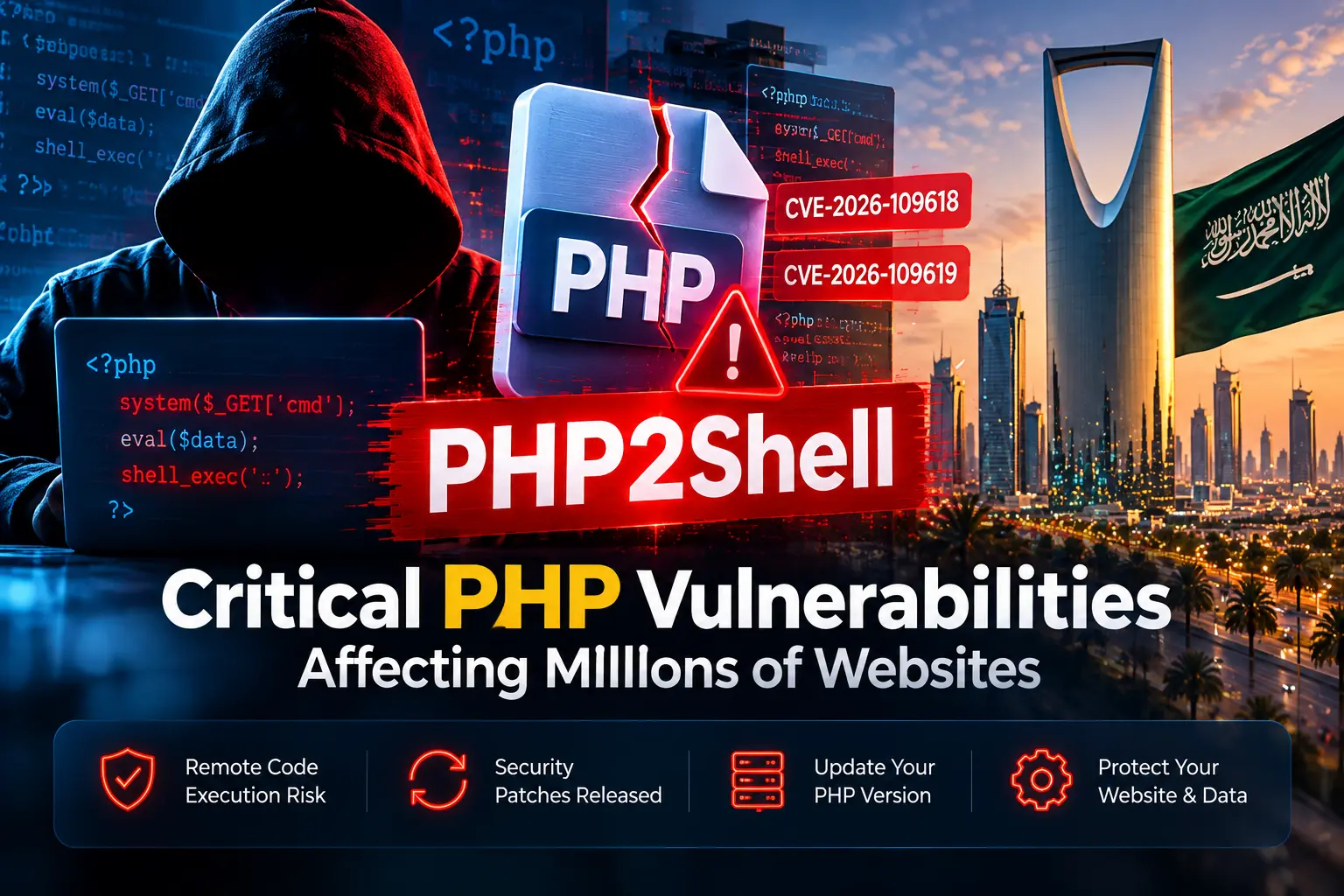
A major PHP security issue is now requiring immediate attention from organizations running PHP-powered websites and web applications. The vulnerabilities, known collectively as PHP2Shell, are tracked as CVE-2026-109618 and CVE-2026-109619 and can allow unauthenticated remote code execution under certain conditions.
For businesses relying on custom PHP applications, custom PHP development services should not stop at building features. Secure development, dependency management, runtime updates, vulnerability monitoring, testing, and ongoing maintenance are equally important.
The PHP project released emergency security updates on October 21, 2026. The fixed versions are PHP 8.5.12, 8.4.27, 8.3.36, and 8.2.35.
Key Takeaways
- PHP2Shell refers to two critical PHP vulnerabilities: CVE-2026-109618 and CVE-2026-109619.
- Both vulnerabilities have a CVSS v4.0 score of 9.2 (Critical).
- The flaws can potentially enable unauthenticated remote code execution.
- PHP released patched versions on October 21, 2026.
- Fixed supported releases include PHP 8.2.35, 8.3.36, 8.4.27 and 8.5.12.
- PHP 8.1 and older branches are end-of-life and do not receive normal upstream security releases.
- AWS reported an attempted PHP2Shell exploitation against its honeypot infrastructure on October 17, four days before public disclosure. AWS later reported broad exploitation attempts after disclosure.
- AI-assisted security research played a significant role in discovering and validating the vulnerabilities.
- Organizations should treat patching internet-facing PHP systems as an urgent security task.
What Is PHP and Why Does PHP2Shell Matter?
PHP is a widely used server-side programming language for websites, web applications, content management systems, ecommerce platforms, and business software.
Its widespread adoption is one reason a vulnerability in the PHP runtime can have an unusually large impact.
According to W3Techs’ October 22, 2026 measurement, PHP was used by 69.3% of websites whose server-side programming language was known.
That makes PHP security relevant to organizations of every size, from small business websites to large enterprise applications.
PHP2Shell is particularly important because the problem exists in PHP itself, rather than being limited to one WordPress plugin, one website theme, or one custom application.
A secure application can still be exposed if its underlying PHP runtime remains vulnerable.
What Is the PHP2Shell Vulnerability?
PHP2Shell is the name commonly used for two related critical vulnerabilities:
- CVE-2026-109618 — RCE via out-of-memory corruption
- CVE-2026-109619 — RCE via stale global state
Both vulnerabilities involve unsafe handling of internal PHP state during exceptional request-processing conditions.
In simplified terms, PHP may enter an abnormal state during request processing. Under specific conditions, internal memory or state can remain invalid or reference memory that is no longer valid.
An attacker can potentially use carefully crafted network requests to reach these conditions and ultimately execute code on the vulnerable server.
The official PHP advisory confirms that both vulnerabilities can result in unauthenticated remote code execution and recommends updating to the fixed releases.
Why Is It Called PHP2Shell?
The term PHP2Shell refers to the research and exploit demonstrations associated with the two vulnerabilities.
It does not mean that PHP itself is a virus.
The correct way to describe the issue is:
PHP2Shell = two critical PHP runtime vulnerabilities that can potentially lead to remote code execution.
Which PHP Versions Are Affected?
The currently documented fixed releases are:
| PHP Branch | Vulnerable Before | Fixed Version |
| PHP 8.5 | 8.5.12 | 8.5.12 |
| PHP 8.4 | 8.4.27 | 8.4.27 |
| PHP 8.3 | 8.3.36 | 8.3.36 |
| PHP 8.2 | 8.2.35 | 8.2.35 |
PHP officially released these security versions on October 21, 2026.
Organizations running older PHP branches should pay particular attention.
PHP 8.1 and older versions are end-of-life from the upstream PHP project’s normal support perspective. Some distributions and long-term-support vendors may provide backported fixes, but organizations should not assume that an old PHP version is protected simply because its displayed version number has not changed.
PHP 8.2 is also scheduled to reach end of life on December 31, 2026, making longer-term migration planning important for organizations still using that branch.
How Serious Is PHP2Shell?
Both vulnerabilities received a CVSS v4.0 score of 9.2, placing them in the Critical category.
The seriousness comes from several factors.
No Authentication Required
The documented attack paths can potentially be triggered without an attacker first logging into the application.
Remote Code Execution
Successful exploitation can allow code to execute with the privileges available to the PHP worker.
Runtime-Level Vulnerability
The issue exists within the PHP runtime, so simply updating a WordPress plugin or application library does not solve the underlying problem.
Large Potential Attack Surface
PHP is used across a substantial portion of the web, making vulnerable internet-facing PHP environments attractive targets.
Exploitation Has Already Been Observed
AWS reported that its threat-intelligence infrastructure recorded an attempted PHP2Shell exploitation on October 17, 2026, before public disclosure. After disclosure, AWS reported additional exploitation attempts and described PHP2Shell as being broadly exploited in the wild.
This is why organizations should not treat the issue as a routine future maintenance task.
Did AI Discover the PHP Vulnerability?
AI played an important role in the discovery and research surrounding PHP2Shell, but the story is more nuanced than saying “AI discovered PHP.”
Security researchers used AI-assisted methods to analyze PHP’s complex code paths, investigate potential vulnerabilities, develop exploit hypotheses, and validate fixes.
Google Cloud reported that Wiz Research used multiple AI models during the research and specifically highlighted the contribution of Gemini 4 Argon to vulnerability discovery, exploit development, attack detection, and patch validation.
OpenAI also reported that Calif identified a critical PHP flaw using GPT-5.6 Sol as part of the Patch the Planet initiative, while Wiz independently discovered and reported both vulnerabilities.
The PHP Foundation’s own account makes an important point: AI tools can accelerate vulnerability research and help validate reports, but human experts still make the decisions around analysis, remediation, compatibility, and patching.
The bigger lesson for businesses is clear:
AI is making both vulnerability discovery and vulnerability analysis faster.
Organizations therefore need faster patch-management and security-response processes.
Why PHP2Shell Is Relevant to Saudi Businesses?
PHP2Shell is not a Saudi-specific vulnerability. It affects the PHP runtime globally.
However, Saudi organizations using PHP-powered websites, ecommerce platforms, customer portals, internal applications, or custom business systems should still assess their exposure.
This is particularly important for organizations operating in:
- Riyadh
- Jeddah
- Dammam
- Al Khobar
- The wider Eastern Province
Potentially affected business environments can include:
- Ecommerce websites
- Corporate websites
- Customer portals
- Booking systems
- Online stores
- Custom PHP applications
- WordPress-based websites
- Drupal applications
- Joomla applications
- Internal business portals
- API-based PHP services
The key question is not:
“Is my website built with WordPress?”
The better question is:
“Which PHP runtime is actually running my application, and has it been patched?”
What Should Saudi Businesses Do Now?
The first priority is to identify every PHP environment in the organization.
This includes production servers, staging servers, development environments, containers, legacy applications, and forgotten subdomains.
1. Inventory PHP Systems
Identify:
- PHP websites
- PHP APIs
- PHP-FPM deployments
- Apache mod_php deployments
- php-cgi environments
- Container images
- Hosting environments
- Legacy applications
- Development servers
PHP’s own advisory specifically identifies PHP-FPM, Apache with mod_php, php-cgi, FrankenPHP and LiteSpeed among the PHP installations serving web requests that require attention.
2. Check the PHP Version
Determine the actual runtime version used by each production system.
Do not rely only on:
- CMS version
- WordPress version
- Plugin versions
- Framework version
The PHP runtime itself must be checked.
3. Upgrade to a Fixed Version
For supported PHP branches, update to:
8.5.12
8.4.27
8.3.36
8.2.35
The PHP project states that updating is the complete remediation for these vulnerabilities.
4. Restart or Redeploy PHP Workers
Simply installing a package does not necessarily mean every running PHP worker has immediately started using the fixed runtime.
Organizations should follow their hosting, operating-system, container, or deployment process to restart/redeploy affected services.
5. Review Logs and Security Monitoring
Because exploitation may have occurred before public disclosure, organizations should review relevant logs and security telemetry.
AWS recommends investigating from at least October 17 for organizations assessing potential PHP2Shell exposure.
Look for:
- Unusual HTTP requests
- Unexpected process execution
- Unexpected file changes
- Suspicious POST requests
- Unexpected administrative activity
- New or modified PHP files
- Unusual outbound connections
- Unexpected account or credential activity
6. Review Application Secrets
If there is evidence that a vulnerable server may have been compromised, organizations should assess whether credentials, API keys, tokens, database passwords, or other secrets accessible to the PHP process need to be rotated.
How Custom PHP Development Services Can Improve Security?
PHP2Shell also highlights an important lesson for organizations commissioning custom software.
Custom PHP development services should include security throughout the software lifecycle, not only during the initial development phase.
A professional development and maintenance process should consider:
Secure Architecture
Applications should be designed with appropriate separation between application logic, databases, authentication systems, storage, and external services.
Dependency Management
Frameworks, libraries, packages, and PHP runtimes should be tracked and updated.
Security Testing
Applications should be tested for common vulnerabilities and configuration weaknesses before deployment.
Runtime Management
The PHP version should be documented and monitored instead of being treated as invisible infrastructure.
Patch Management
Critical security updates should have an established review, testing, and deployment process.
Monitoring
Production systems should have appropriate logging, monitoring, and alerting.
Backup and Recovery
Organizations should maintain tested backups and recovery procedures for important business applications.
Legacy Application Modernization
Old PHP applications can become difficult to maintain when their runtime, framework, libraries, and infrastructure are no longer supported.
Modernization can reduce technical debt and make future security updates easier.
PHP2Shell and WordPress, Drupal, Joomla and Other PHP Applications
One common misunderstanding is that PHP2Shell is a WordPress vulnerability.
It is not.
The vulnerability exists in the PHP runtime.
That means a website running WordPress, Drupal, Joomla, or another PHP-based application may still require attention if the underlying PHP installation is vulnerable.
NHS England reported successful demonstrations involving products integrating PHP, including WordPress, Drupal and Joomla.
This is an important distinction:
Updating the CMS does not replace updating PHP.
Both application-level and infrastructure-level security need to be maintained.
What About XAMPP, Localhost and PHP Online Compilers?
Search interest around this incident includes terms such as XAMPP, localhost, PHP compiler, PHP online compiler, test.php, index.php, and W3Schools PHP.
These should not be confused with the PHP2Shell vulnerability itself.
PHP2Shell is a vulnerability in the PHP runtime.
A local development environment such as XAMPP is not automatically an internet-facing vulnerable server simply because it contains PHP. The security concern depends on how and where PHP is deployed and whether it serves network requests.
Likewise, an online PHP compiler or educational website is not evidence that a particular business website is vulnerable.
For organizations, the meaningful question remains:
Is an affected PHP runtime serving web requests in an environment that could be reached by an attacker?
How a Professional PHP Security Remediation Process Works?
A structured remediation process can follow this sequence:
Discover → Identify → Assess → Patch → Test → Redeploy → Monitor → Verify
Discover
Find every PHP environment across production, cloud, containers, staging, and legacy systems.
Identify
Determine the exact PHP runtime and deployment architecture.
Assess
Prioritize internet-facing systems and systems handling sensitive business information.
Patch
Upgrade to the appropriate fixed PHP release.
Test
Verify application compatibility after the update.
Redeploy
Restart PHP workers, rebuild affected container images, or redeploy applications where required.
Monitor
Look for indicators of suspicious activity and unexpected changes.
Verify
Confirm that all environments are running supported, patched versions.
This process is especially important for companies with multiple branches, applications, websites, or cloud environments.
How to Choose a PHP Development Company in Saudi Arabia?
When choosing a provider for custom PHP development services in Saudi Arabia, businesses should look beyond design and coding.
Ask the provider:
Do you provide security-focused development?
The provider should understand secure application architecture and vulnerability management.
Do you manage PHP versions?
A professional provider should know which PHP runtime the application requires and how it is maintained.
Can you modernize legacy PHP?
Legacy applications may require upgrades to PHP, frameworks, libraries, and infrastructure.
Do you test before deployment?
Security and compatibility testing can reduce deployment risk.
Can you integrate existing systems?
Many Saudi businesses need PHP applications connected to:
- ERP systems
- CRM
- POS
- Payment gateways
- Mobile applications
- APIs
- Business automation platforms
Do you provide post-launch support?
A website or application needs maintenance after launch.
Security updates do not stop when development ends.
Safha Technologies’ Approach to Custom PHP Development
Safha Technologies provides digital solutions for businesses that need websites, custom software, mobile applications, UI/UX design, AI solutions, business automation, CRM, POS, ERP and other technology services.
For organizations running custom PHP applications, Safha’s approach can focus on the complete lifecycle:
Business Requirements → Architecture → UI/UX → Development → Integration → Testing → Deployment → Security Maintenance
A security-conscious PHP project should also include:
- Supported PHP versions
- Secure application architecture
- Dependency management
- Database security
- Authentication controls
- API security
- Logging
- Backup strategy
- Security updates
- Performance monitoring
- Future scalability
For Saudi businesses in Riyadh, Jeddah, Dammam, Al Khobar and across the Eastern Province, this approach helps connect application development with practical business requirements.
PHP Security Is Now a Continuous Process
PHP2Shell is another reminder that software security is not a one-time development task.
A website may have been secure when it launched but become exposed later because:
- The PHP version becomes outdated.
- A dependency becomes vulnerable.
- A framework reaches end of life.
- A server configuration changes.
- A third-party integration introduces risk.
- Security patches are delayed.
This is why organizations need an ongoing software maintenance strategy.
For companies using custom applications, custom PHP development services should ideally include long-term security and modernization planning.
Conclusion
PHP2Shell has turned PHP security into an urgent topic for web developers, IT managers, CTOs and business owners.
The two vulnerabilities, CVE-2026-109618 and CVE-2026-109619, are rated Critical with CVSS v4.0 scores of 9.2 and can enable unauthenticated remote code execution under affected conditions.
PHP has released fixed versions:
PHP 8.5.12
PHP 8.4.27
PHP 8.3.36
PHP 8.2.35
Organizations should identify vulnerable PHP environments, apply the appropriate security updates, redeploy or restart affected services, and review security telemetry for signs of compromise.
The incident also demonstrates how AI-assisted security research is accelerating vulnerability discovery and analysis.
For businesses, the lesson is simple:
Secure software requires continuous maintenance—not just successful development.
If your organization is running a custom PHP website or business application, Safha Technologies can help you assess your requirements, modernize applications, develop secure digital solutions, and build technology that is designed for long-term business growth.
Safha Technologies — Smarter Technology for Stronger Businesses.