


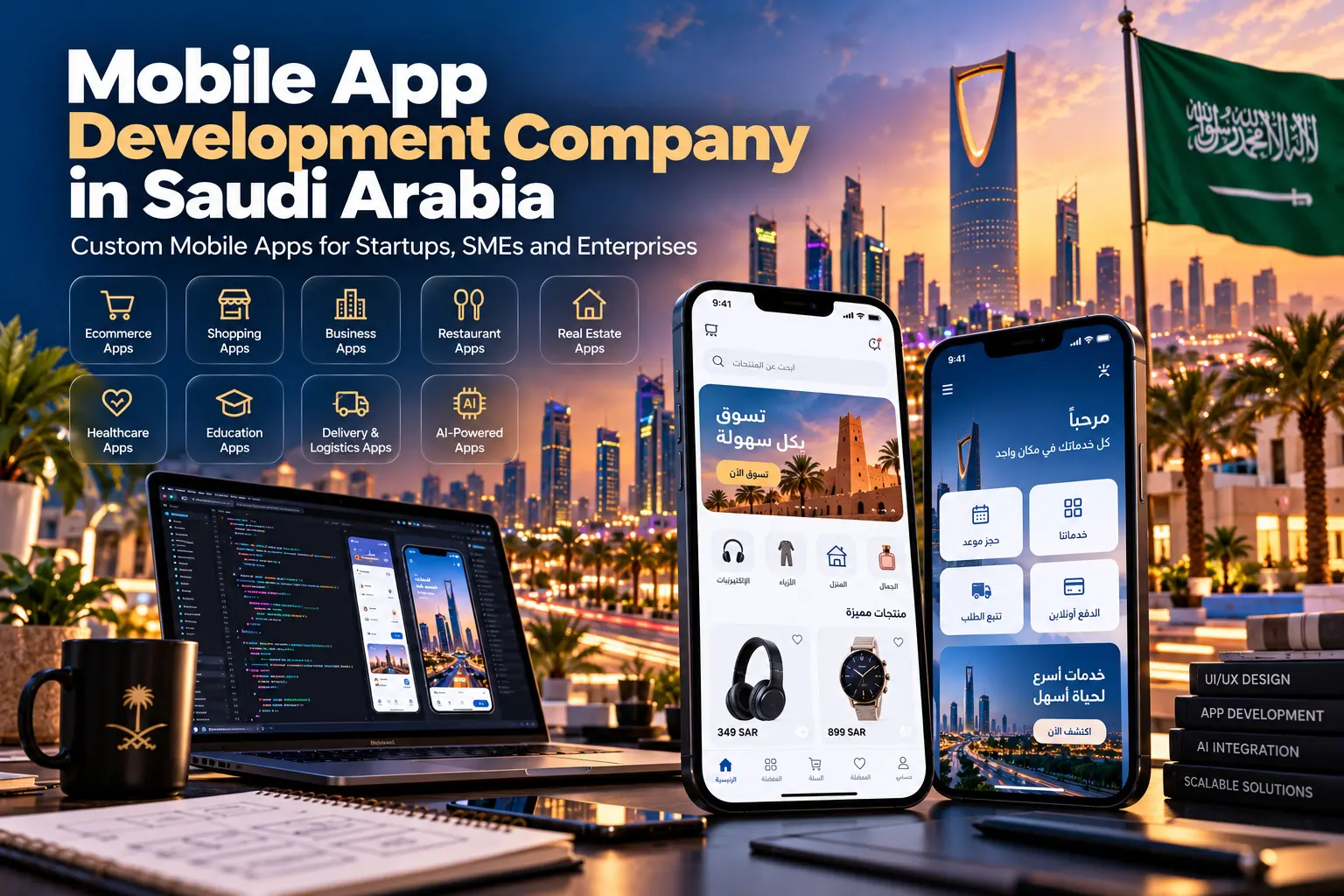
Saudi businesses are increasingly using mobile applications to improve customer engagement, simplify operations, and create new digital services. From shopping apps and fintech platforms to healthcare, education, delivery, and business applications, mobile technology has become an important part of digital growth.
Professional mobile app development services help businesses transform an idea into a secure, scalable, and user-friendly mobile application. Whether you are a Saudi startup, SME, or enterprise operating in Riyadh, Jeddah, Dammam, Al Khobar, or elsewhere in the Kingdom, the right development approach can help you build an application around your customers and business objectives.
Key Takeaways
- Mobile applications can support sales, customer engagement, operations, and digital services.
- Saudi businesses can develop applications for ecommerce, shopping, healthcare, education, logistics, finance, restaurants, and other industries.
- Native development can provide strong performance and platform-specific experiences.
- Cross-platform development can help businesses efficiently target multiple mobile platforms.
- UI/UX design is essential for creating an easy and engaging mobile experience.
- AI, APIs, cloud services, analytics, and third-party integrations can extend an application’s capabilities.
- A reliable mobile app development company in Saudi Arabia should understand both technology and local business requirements.
- Safha Technologies develops custom digital solutions based on business goals, user requirements, and scalability.
What Are Mobile App Development Services?
Mobile app development services cover the complete process of planning, designing, developing, testing, launching, and maintaining applications for smartphones and tablets.
Depending on the project, services can include:
- Business app development
- Ecommerce and shopping apps
- Customer portals
- Booking applications
- Delivery and logistics apps
- Education and LMS applications
- Healthcare applications
- Employee applications
- Fintech and financial applications
- AI-powered mobile applications
- Custom enterprise applications
- API and third-party integrations
- Cloud application development
- UI/UX design
- Application maintenance and support
The purpose is not simply to build an app. A successful application should solve a real business problem and provide customers with a simple, reliable, and useful experience.
Why Mobile Apps Matter for Saudi Businesses?
Saudi Arabia has a rapidly developing digital economy, making mobile applications increasingly relevant for businesses of different sizes.
Customers expect businesses to provide convenient digital experiences, including:
- Easy product discovery
- Online ordering
- Digital payments
- Appointment booking
- Real-time notifications
- Customer support
- Personalized experiences
- Self-service options
For businesses in Riyadh, Jeddah, Dammam, Al Khobar, and the Eastern Province, a mobile application can become another important digital channel connecting the business with its customers.
For startups, mobile apps can also help validate new business ideas and create scalable digital products.
Mobile App Development for Saudi Startups
Saudi startups often need to move quickly while keeping their technology flexible enough to grow.
A startup application may begin with a focused MVP and expand as the business gains customers.
For example:
Business idea → UI/UX prototype → MVP → Customer feedback → New features → Scalable application
This approach helps startups prioritize essential features before investing in more advanced functionality.
Mobile applications can support Saudi startups in areas such as:
- Ecommerce
- Shopping
- Delivery
- Food and restaurants
- Transportation
- Education
- Healthcare
- Professional services
- SaaS
- Marketplaces
A development partner should therefore understand not only coding, but also product strategy and business objectives.
Shopping Apps and Ecommerce Applications
Shopping apps provide customers with a direct mobile channel for discovering products and completing purchases.
A modern ecommerce application can include:
- Product catalogs
- Search and filters
- Product details
- Shopping carts
- Wishlists
- Customer accounts
- Online payments
- Order tracking
- Push notifications
- Promotions
- Reviews and ratings
Businesses already investing in ecommerce website development may also benefit from a mobile application that complements their website.
The website and mobile application can share backend systems, inventory, customer data, orders, and other business processes when the architecture is designed correctly.
Native Development vs Cross-Platform Development
One of the key decisions in mobile application development is choosing the right technology approach.
Native Development
Native development involves building applications specifically for a particular mobile operating system.
Advantages can include:
- Strong platform performance
- Better access to device capabilities
- Platform-specific user experiences
- Greater control over native features
Native development can be suitable for applications that require advanced device functionality or highly optimized performance.
Cross-Platform Development
Cross-platform development allows businesses to create applications for multiple platforms using a shared development approach.
It can provide:
- Faster development
- Shared code
- Easier maintenance
- Efficient multi-platform deployment
The best choice depends on the application’s requirements, budget, timeline, performance needs, and long-term roadmap.
UI/UX Design for Mobile Applications
A technically powerful application can still fail if users find it confusing or difficult to navigate.
Professional UI/UX design focuses on creating an experience that is:
- Simple
- Clear
- Fast
- Accessible
- Consistent
- Mobile-friendly
The process may include:
User Research
Understanding the target audience, their needs, and their behavior.
User Flow
Mapping the steps users take to complete important actions.
Wireframes
Creating the basic structure of application screens.
UI Design
Developing the visual identity, typography, icons, components, and layouts.
Prototype
Creating an interactive version of the application before development.
For Saudi applications, Arabic and English support may also require careful consideration of RTL and LTR layouts.
AI-Powered Mobile Applications
Artificial intelligence can add intelligent capabilities to mobile applications.
Depending on the use case, AI can support:
- AI chat assistants
- Recommendations
- Document processing
- Image recognition
- Voice interaction
- Search
- Personalization
- Automated customer support
- Predictive insights
For example, a shopping application could use AI to improve product recommendations, while a business application could use AI to summarize information or automate repetitive tasks.
AI should be introduced where it creates measurable value rather than simply being added as a trend.
Cloud and API Integration
Modern mobile applications often depend on backend services, cloud platforms, APIs, databases, and third-party systems.
A mobile application may need to connect with:
- Payment gateways
- Ecommerce platforms
- CRM systems
- ERP systems
- POS systems
- Maps
- SMS services
- Email platforms
- Authentication systems
- Analytics tools
- AI services
Cloud-based architecture can help applications scale as user demand increases.
For businesses with existing systems, API integration can allow the mobile app to communicate with their current technology ecosystem rather than creating completely separate processes.
Mobile Apps for Different Saudi Industries
Mobile application development is not limited to ecommerce.
Retail
Shopping, loyalty, promotions, inventory-related services, and customer engagement.
Restaurants
Online ordering, delivery, reservations, loyalty programs, and customer communication.
Healthcare
Appointments, patient portals, notifications, and healthcare service management.
Education
Student applications, learning platforms, communication, attendance, and LMS integration.
Real Estate
Property discovery, listings, bookings, agent communication, and customer management.
Logistics
Delivery tracking, driver applications, route management, and real-time updates.
Enterprise
Employee services, workflows, dashboards, approvals, CRM, and business automation.
How Mobile App Development Works?
A professional development process usually follows several stages.
1. Requirement Analysis
The development team understands the business, target users, features, integrations, and project objectives.
2. Product Planning
The application structure, technology stack, user flows, and development roadmap are defined.
3. UI/UX Design
Screens, user journeys, prototypes, and visual components are created.
4. Development
Developers build the application, backend, APIs, database, and required integrations.
5. Testing
The application is tested for functionality, usability, security, compatibility, and performance.
6. Deployment
The application is prepared for the appropriate app stores and production environment.
7. Maintenance
After launch, applications may require updates, improvements, security patches, monitoring, and new features.
How to Choose an App Development Company in Saudi Arabia?
Choosing the right app development company in Saudi Arabia requires more than comparing quotations.
Consider the following:
Technical Experience
Review experience with the technologies required for your project.
Relevant Portfolio
Look for applications similar to your industry or business model.
UI/UX Capability
A development company should be able to create a practical and attractive user experience.
Integration Experience
Ask about experience with APIs, payment systems, ERP, CRM, ecommerce, AI, and other required platforms.
Arabic and English Support
For Saudi businesses, the ability to handle Arabic interfaces and RTL layouts can be important.
Security
Applications handling customer, payment, or business information require appropriate security practices.
Scalability
The architecture should allow the application to grow as users and business requirements increase.
Post-Launch Support
Ask how updates, bug fixes, monitoring, and future development will be handled.
Safha Technologies’ Approach to Mobile App Development
At Safha Technologies, mobile application development starts with understanding the business problem rather than simply selecting a technology.
Our approach can include:
- Business and requirement analysis
- Product planning
- UI/UX design
- Custom mobile app development
- Native and cross-platform development
- Backend and API development
- AI integration
- Cloud solutions
- Third-party integrations
- Testing and quality assurance
- Deployment support
- Ongoing maintenance
Safha also provides broader digital solutions including custom software, website development, CRM, Odoo ERP, POS, LMS, AI solutions, AI document management, AI attendance, and business automation.
This allows businesses to connect their mobile application with a wider digital ecosystem when required.
Benefits of Professional Mobile App Development
A professionally developed mobile application can help businesses:
Improve Customer Experience
Give customers a convenient digital channel for accessing products and services.
Strengthen Brand Presence
Create a dedicated digital experience around the company’s brand.
Automate Business Processes
Reduce repetitive manual processes through digital workflows.
Increase Accessibility
Allow customers and employees to access services from mobile devices.
Connect Business Systems
Integrate mobile applications with CRM, ERP, e-commerce, POS, payment, and other systems.
Support Business Growth
Build an application architecture that can evolve as the business grows.
Conclusion
Professional mobile app development services can help Saudi businesses turn digital ideas into practical mobile products.
Whether you are developing a shopping app, e-commerce application, business platform, AI-powered app, customer portal, education application, healthcare solution, or enterprise system, the right combination of strategy, UI/UX, development, integrations, security, and ongoing support is essential.
For businesses in Riyadh, Jeddah, Dammam, Al Khobar, and the wider Saudi market, a well-designed mobile application can become an important part of a broader digital transformation strategy.
Build Your Mobile Application With Safha Technologies
Have an application idea or an existing business process that you want to digitize?
Discuss your requirements with Safha Technologies and explore a custom mobile application designed around your users, business goals, and future growth.