



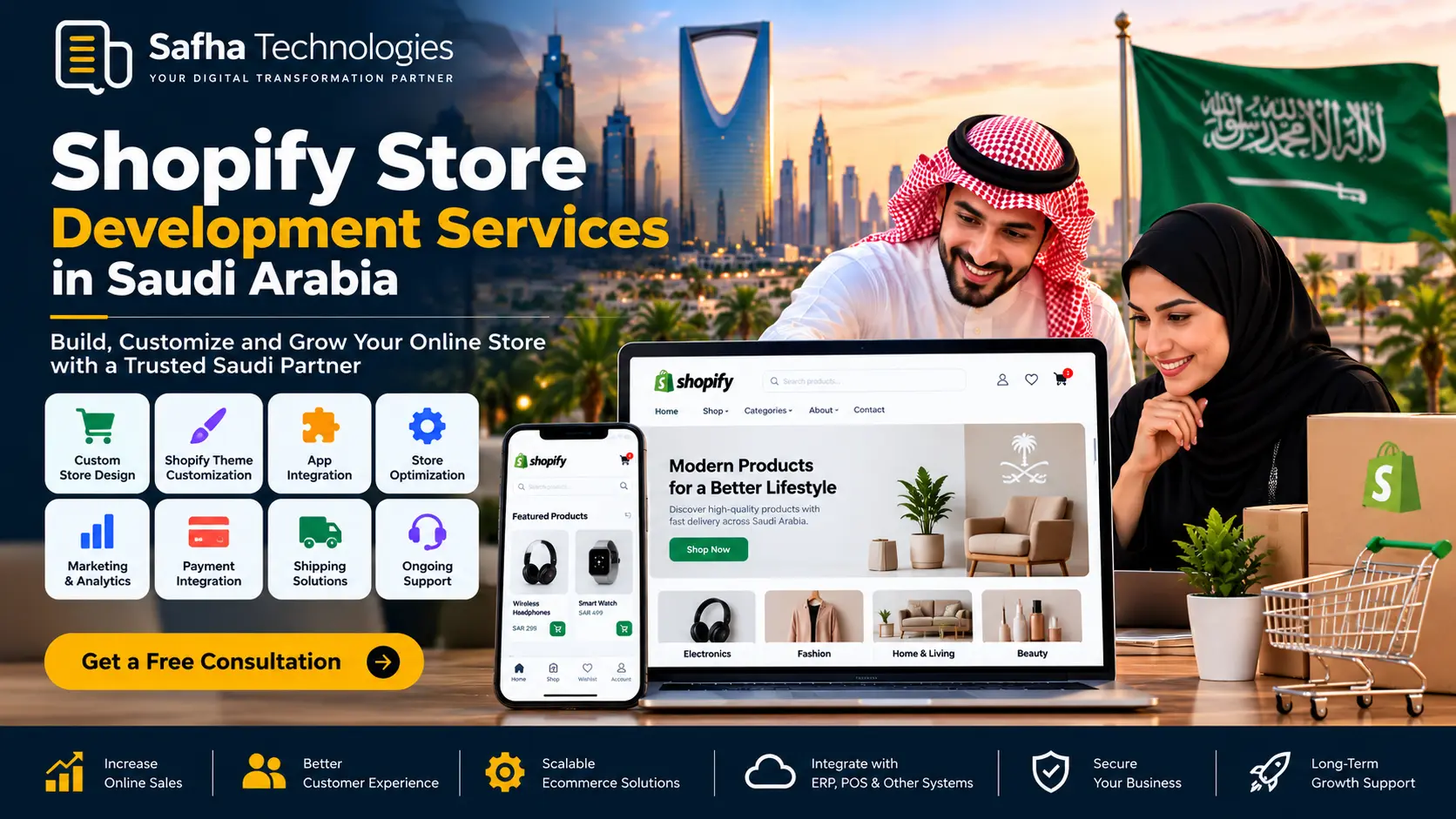
The growth of online shopping has created new opportunities for businesses across Saudi Arabia. From startups in Riyadh to established retailers in Jeddah, Dammam, Al Khobar and the wider Eastern Province, businesses need ecommerce stores that are fast, mobile-friendly, secure and easy to manage.
Shopify store development services help businesses build, customize and optimize ecommerce stores using Shopify. A professional Shopify store can go beyond attractive design by connecting products, payments, inventory, marketing, analytics and customer management in one digital commerce environment.
For Saudi businesses, the right Shopify solution should also consider Arabic and English content, local customer expectations, payment requirements, shipping workflows and integration with other business systems.
Key Takeaways
- Shopify is a hosted ecommerce platform for creating and managing online stores.
- Professional development can turn a standard Shopify store into a customized ecommerce experience.
- Businesses can customize Shopify themes, navigation, product pages and checkout experiences.
- Shopify apps can extend the functionality of an online store.
- Shopify can be connected with marketing, analytics, inventory and other business systems.
- Saudi businesses should consider Arabic support, mobile shopping, local payments and delivery workflows.
- Shopify is not automatically the best option for every business; requirements should be assessed before choosing a platform.
- Safha Technologies can help businesses plan and develop ecommerce solutions around their specific requirements.
What Is Shopify?
Shopify is an ecommerce platform that allows businesses to create, operate and manage online stores without building the entire ecommerce infrastructure from scratch.
A Shopify store can include:
- Product catalogs
- Product variants
- Shopping carts
- Customer accounts
- Orders
- Inventory
- Discount codes
- Marketing integrations
- Analytics
- Shipping options
- Payment integrations
- Mobile-friendly storefronts
Someone searching what is Shopify is essentially looking for an ecommerce platform that simplifies the process of launching and managing an online store.
For Saudi businesses, Shopify can be used to create stores serving customers locally and internationally, depending on the business model, integrations and available services.
Shopify Store Development Services
A successful Shopify store requires more than simply selecting a template and uploading products.
Shopify development services can include:
Store Setup
Configuring the store structure, products, collections, navigation, domains and essential settings.
Shopify Theme Customization
A Shopify theme controls much of the visual appearance and user experience of the store.
Customization can include:
- Homepage design
- Product pages
- Collection pages
- Navigation
- Typography
- Layout
- Mobile experience
- Brand elements
Businesses can use existing Shopify themes or develop a more customized storefront according to their requirements.
Custom Shopify Development
Custom functionality can be developed when standard Shopify features or apps are not enough.
This may include:
- Custom product experiences
- Advanced filtering
- Special pricing logic
- Custom sections
- Business-specific workflows
- Third-party integrations
- Custom customer experiences
Shopify Development Agency: Why Professional Development Matters
A professional Shopify development agency can help businesses avoid treating ecommerce as simply a website project.
A successful store needs to consider the entire customer journey:
Landing page → Product discovery → Product page → Cart → Checkout → Payment → Delivery → Customer support → Repeat purchase
Small problems at any stage can affect the customer experience.
Professional development focuses on:
- Performance
- Usability
- Mobile responsiveness
- Search functionality
- Product organization
- Conversion-focused design
- Integrations
- Analytics
- Scalability
For businesses in Riyadh, Jeddah, Dammam and Al Khobar, the store should also reflect the expectations of Saudi online shoppers.
Shopify vs Other Ecommerce Platforms
Shopify is one option among several ecommerce platforms.
Depending on the business requirements, companies may also consider:
- WooCommerce
- Salla
- Custom ecommerce development
- Other enterprise ecommerce platforms
For example, WooCommerce development services may be suitable for businesses that already use WordPress and want greater control over their website infrastructure.
On the other hand, Shopify may be attractive to businesses looking for a hosted ecommerce environment with a large ecosystem of themes, apps and integrations.
The right choice depends on:
- Business size
- Product complexity
- Budget
- Required integrations
- Level of customization
- Technical resources
- Expected growth
- Local market requirements
Shopify in Saudi Arabia
Ecommerce in Saudi Arabia requires more than simply translating an international store into Arabic.
A Saudi-focused ecommerce store should consider:
Arabic and English
Many businesses serve customers who prefer Arabic, English or both. The user experience should therefore support the appropriate language structure and content.
Mobile Shopping
A large portion of ecommerce interaction takes place through mobile devices, making responsive design essential.
Local Payments
Businesses should evaluate the payment methods and payment providers that are appropriate for their Saudi customers and business structure.
Delivery
Shipping options, delivery areas, order tracking and return workflows should be considered during development.
Customer Experience
Product information, pricing, delivery details, returns and customer support should be presented clearly.
A Shopify store serving customers in Riyadh, Jeddah, Dammam, Al Khobar and the Eastern Province should be designed around these practical requirements rather than simply copying an international ecommerce template.
Shopify Apps and Integrations
One of Shopify’s major advantages is its ecosystem of applications.
The Shopify App Store provides applications that can extend store functionality.
Depending on business requirements, apps can support areas such as:
- Marketing
- Customer reviews
- Loyalty
- Inventory
- Shipping
- Analytics
- Customer support
- Product customization
- Social commerce
However, installing too many apps can create unnecessary complexity.
A professional Shopify developer should evaluate whether a business actually needs an app, a native Shopify feature, an integration or custom development.
Shopify Admin and Store Management
The Shopify admin provides the central management environment for the online store.
Business teams can use it to manage areas such as:
- Products
- Orders
- Customers
- Inventory
- Discounts
- Store settings
- Analytics
- Applications
Searches such as Shopify admin login, Shopify store login, Shopify login and Shopify sign up are generally related to accessing or creating Shopify accounts.
For a business, however, having access to Shopify is only the beginning. The real value comes from configuring the store correctly and creating an efficient ecommerce operation.
Shopify Payments and Payment Integration
Payment processing is an essential part of ecommerce development.
Businesses searching for Shopify Payments should first determine which payment services and features are currently available for their specific business location, account setup and market.
For Saudi ecommerce businesses, payment integration should be evaluated alongside:
- Currency
- Customer payment preferences
- Transaction workflow
- Refunds
- Order management
- Accounting
- Reconciliation
- Security
The payment solution should fit the overall ecommerce operation rather than being treated as an isolated feature.
Shopify Analytics and Ecommerce Growth
Launching a store does not mean the ecommerce project is finished.
Shopify analytics and other analytics tools can help businesses understand:
- Where visitors come from
- Which products receive attention
- Which pages perform well
- Where customers leave the buying journey
- Sales performance
- Customer behavior
- Marketing performance
These insights can support continuous improvement.
For example:
Traffic → Product views → Add to cart → Checkout → Purchase
If a large number of users view products but very few add them to the cart, the business may need to investigate pricing, product information, images, usability or customer trust signals.
Shopify Developer Near Me: What Should You Look For?
Businesses searching for a Shopify developer near me should look beyond location alone.
A suitable developer or development partner should understand:
- Ecommerce UX
- Shopify development
- Theme customization
- App integrations
- APIs
- Payment integrations
- Analytics
- Mobile optimization
- SEO
- Business workflows
- Data security
It is also important to ask whether the developer can support the store after launch.
A Shopify store is an ongoing business platform, not a one-time website.
When Should You Hire a Shopify Developer?
You may need to hire a Shopify developer when:
- Your store needs custom functionality.
- The existing theme does not match your brand.
- You need third-party integrations.
- Your business has complex product structures.
- You need custom customer experiences.
- Your store requires performance optimization.
- You need Arabic and English experiences.
- You want to connect Shopify with ERP, POS or other business systems.
For simple stores, standard Shopify features may be enough. For more complex operations, professional development can save time and reduce technical problems.
Shopify Partner and Professional Support
A Shopify Partner can provide services around store development, design, customization and other Shopify-related work.
When evaluating a partner or development company, businesses should look at:
- Relevant ecommerce experience
- Previous Shopify projects
- Development capabilities
- Integration experience
- Understanding of the Saudi market
- Post-launch support
- Communication and project management
The goal should be to find a partner that understands both the technology and the business objective.
Shopify Store Development for Saudi Businesses
A Shopify store can support many Saudi business models.
Retail
Sell clothing, accessories, electronics, beauty products, home products and other consumer goods online.
Food and Specialty Products
Build online ordering and product catalogs for selected food and specialty businesses.
B2B Ecommerce
Create digital ordering experiences for businesses serving wholesale or corporate customers.
Direct-to-Consumer Brands
Build a branded ecommerce experience that connects products, marketing and customer data.
Omnichannel Businesses
Businesses operating physical stores can explore integrations between ecommerce, POS, inventory and customer management.
Shopify and Business System Integration
Ecommerce should not operate separately from the rest of the company.
Depending on the requirements, Shopify can be integrated with systems such as:
- ERP
- POS
- Customer management systems
- Accounting
- Inventory management
- Shipping platforms
- Marketing tools
- Business analytics
- Mobile applications
For example:
Shopify Store → Order → Inventory → POS/ERP → Fulfillment → Customer Notification
This type of integration can reduce manual work and provide better visibility across the business.
Shopify Store Development Services from Safha Technologies
At Safha Technologies, ecommerce development starts with understanding the business rather than immediately choosing a template.
Our approach can include:
1. Business & Requirement Analysis
Understand products, customers, sales channels, operations and growth objectives.
2. Ecommerce Planning
Define the store structure, navigation, product organization and customer journey.
3. UI/UX Design
Create a clear and conversion-focused shopping experience.
4. Shopify Development
Configure, customize and develop the required Shopify functionality.
5. Integrations
Connect the store with relevant business systems and third-party services.
6. Testing
Review the store across devices, pages, checkout processes and key customer journeys.
7. Launch & Support
Deploy the store and provide ongoing technical support and improvements.
Safha can also support broader digital requirements through custom software, ERP, POS, AI solutions, mobile applications, website development and business automation.
How to Choose the Right Shopify Development Company?
Before selecting a Shopify development company, ask:
Does the company understand your business?
Technical skills alone are not enough. The developer should understand your products, customers and business model.
Can they customize Shopify?
Check whether they can modify themes and develop functionality beyond standard configurations.
Can they integrate other systems?
This becomes especially important for established businesses using ERP, POS, accounting or inventory systems.
Do they understand Saudi ecommerce?
The partner should understand Arabic content, local customer expectations and Saudi business requirements.
Do they provide support?
Ask what happens after the store launches.
Can the solution scale?
Your ecommerce infrastructure should be able to support future products, customers, integrations and business growth.
Conclusion
Shopify store development services can help businesses build a professional ecommerce presence without having to develop an entire ecommerce platform from scratch.
The right Shopify solution combines design, development, mobile optimization, product management, integrations, analytics and customer experience.
For businesses in Saudi Arabia, the store should also be designed around local customer expectations, Arabic and English content, payment options, delivery workflows and the company’s wider digital ecosystem.
Whether you are launching a new ecommerce store in Riyadh or expanding an existing business across Jeddah, Dammam, Al Khobar and the Eastern Province, choosing the right development approach can create a stronger foundation for long-term ecommerce growth.
Build Your Shopify Store With Safha Technologies
Ready to launch or improve your ecommerce store?
Discuss your requirements with Safha Technologies and explore tailored ecommerce, Shopify, custom software, ERP, POS and business automation solutions.