



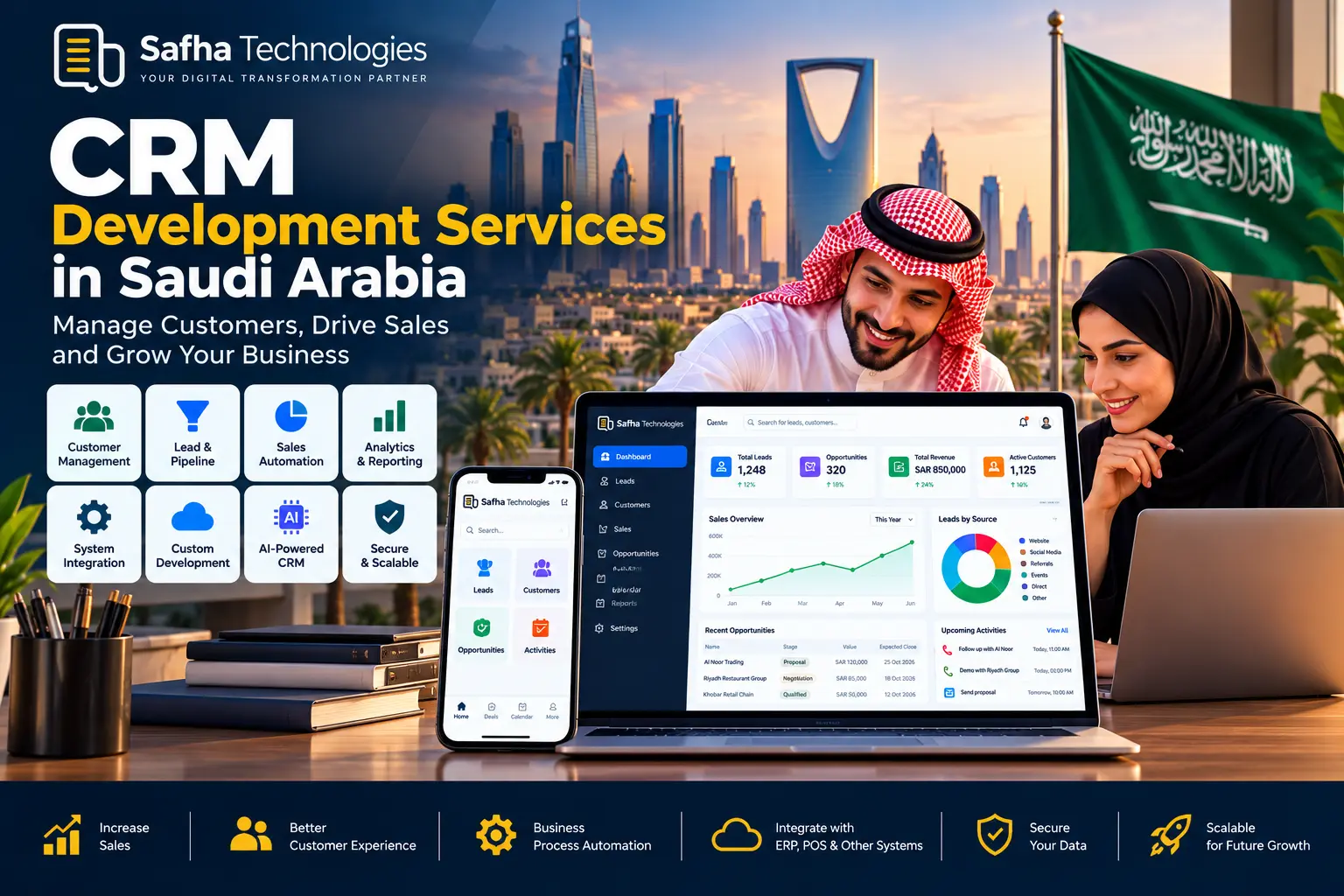
If your sales team manages customers through spreadsheets, WhatsApp conversations, emails, and separate systems, important information can easily get lost. This is where CRM development services can make a difference.
A CRM system brings customer information, sales activities, follow-ups, communication, opportunities, and reporting into one organized platform. CRM stands for Customer Relationship Management and is designed to help businesses manage relationships with prospects and existing customers more effectively.
For businesses in Saudi Arabia, whether operating in Riyadh, Jeddah, Dammam, Al Khobar, or across the Eastern Province, a CRM can become an important part of the digital business infrastructure.
Key Takeaways
- CRM stands for Customer Relationship Management.
- A CRM system centralizes customer and sales information.
- CRM software can help manage leads, opportunities, follow-ups, and customer interactions.
- CRM integration can connect customer data with ERP, websites, ecommerce, email, POS, and other business systems.
- Small businesses may need a simple CRM, while enterprises may require customized CRM platforms.
- Popular CRM platforms include Salesforce, Zoho CRM, Microsoft CRM, Pipedrive, Creatio CRM, monday CRM, and Odoo CRM.
- Custom CRM development is useful when standard software does not fully match a company’s workflow.
- Saudi businesses can benefit from CRM solutions designed around their local operations, teams, customers, and growth plans.
What Is a CRM System?
A CRM system is software used to organize and manage information about customers and potential customers.
The CRM full form is Customer Relationship Management.
In simple terms, CRM helps a business answer questions such as:
- Who is this customer?
- When did we last contact them?
- What products or services are they interested in?
- What stage is their sales opportunity at?
- Who is responsible for the account?
- What follow-up should happen next?
- What is the expected value of the opportunity?
Instead of keeping this information in different spreadsheets, emails, and personal notes, a CRM can provide a centralized view of customer relationships.
Modern CRM platforms can also manage sales pipelines, activities, communications, customer records, reporting, and automation. For example, Odoo CRM supports lead and opportunity management, pipeline tracking, activities, communication, reporting, and integration with other business applications.
CRM Meaning and CRM Full Form
People searching for CRM meaning, CRM mean, CRM stands for, CRM stand for, or what is CRM are generally looking for the same basic explanation.
CRM stands for Customer Relationship Management.
The term describes both the business strategy and the technology used to manage customer relationships.
A CRM can help organizations organize information throughout the customer journey:
Lead → Qualification → Opportunity → Proposal → Sale → Follow-Up → Customer Relationship
This makes CRM particularly valuable for sales teams that handle many prospects and customers simultaneously.
What Does a CRM System Do?
A CRM system can support several areas of business operations.
Lead Management
Capture and organize leads from websites, campaigns, forms, calls, social media, and other sources.
Sales Pipeline Management
Track opportunities through different stages, from initial contact to closing.
Customer Management
Maintain customer profiles, contact details, communication history, preferences, and relevant business information.
Follow-Up Management
Create tasks, reminders, calls, meetings, and follow-up activities so opportunities do not disappear.
Reporting and Analytics
Give management visibility into sales activity, pipeline performance, expected revenue, and team performance.
Automation
Automate repetitive tasks such as lead assignment, notifications, follow-ups, and certain communication workflows.
These capabilities are common across modern CRM platforms, although the exact features depend on the selected system and configuration.
Why Do Businesses Need CRM Software?
As a business grows, customer information becomes harder to manage manually.
A sales manager may have one list of customers, a salesperson may have another, and customer communication may be spread across email, phone calls, and messaging platforms.
This can create problems such as:
- Missed follow-ups
- Duplicate customer records
- Poor visibility
- Lost sales opportunities
- Inconsistent customer communication
- Difficult reporting
- Manual data entry
A CRM system creates a more structured way to manage this information.
For example:
New Lead → Assigned Salesperson → Follow-Up → Meeting → Proposal → Negotiation → Closed Deal
The management team can then see where opportunities are and what actions are required.
CRM Development Services vs. Ready-Made CRM Software
Not every business needs to build a CRM from scratch.
There are two main approaches.
Ready-Made CRM Platforms
Businesses can choose established platforms such as:
- Salesforce CRM
- Zoho CRM
- Microsoft CRM
- Pipedrive
- Creatio CRM
- monday CRM
- Odoo CRM
- Zoho One
- Zoho CRM Plus
- Oracle CRM
These platforms can provide a broad set of CRM capabilities without requiring a completely new system.
Custom CRM Development
CRM development services become particularly valuable when a business has workflows that cannot be handled efficiently through standard configurations.
A custom CRM can be designed around:
- Unique sales processes
- Industry-specific workflows
- Custom approval processes
- Special reporting requirements
- Customer portals
- Arabic and English interfaces
- Internal business systems
- Existing ERP platforms
- E-commerce systems
- Mobile applications
The objective is not simply to build more features. It is to build a CRM that fits the way the organization actually works.
CRM Platforms for Enterprise Financial Institutions
Large organizations and financial institutions can have significantly more complex CRM requirements than small businesses.
They may require:
- Multiple departments
- Large customer databases
- Complex approval workflows
- Role-based permissions
- Detailed audit trails
- Advanced reporting
- Multiple customer segments
- Integration with core business systems
- Strong security controls
For this reason, CRM platforms for enterprise financial institutions are generally evaluated differently from lightweight CRM tools for small businesses.
The right platform should be selected according to organizational requirements, security policies, regulatory considerations, integration needs, and business processes.
Best CRM Software for Small Business
The best CRM software for small business is not necessarily the platform with the largest number of features.
A small business should consider:
- Ease of use
- Cost
- Number of users
- Sales workflow
- Mobile access
- Reporting
- Integrations
- Automation
- Scalability
- Customer support
A simple CRM that the team actually uses can be more valuable than a complex platform that employees avoid.
For some businesses, platforms such as Zoho CRM or Pipedrive may be suitable. Others may prefer an integrated ecosystem such as Odoo, especially when CRM needs to connect with sales, inventory, accounting, ecommerce, or other business applications. Odoo describes its CRM as part of a broader integrated business application suite.
CRM Integration: Connecting Your Business Systems
CRM becomes more powerful when it does not operate in isolation.
CRM integration can connect customer information with other systems such as:
- ERP
- Ecommerce
- Website
- POS
- Accounting
- Marketing platforms
- Customer support
- Mobile applications
- Business intelligence tools
For example:
Website Form → CRM → Sales Team → Proposal → ERP → Invoice → Customer Follow-Up
This reduces unnecessary manual data entry and can give teams a more complete view of the customer.
Odoo, for example, offers CRM functionality integrated with sales and other business applications.
CRM and ERP: What Is the Difference?
CRM and ERP are related but serve different primary purposes.
CRM
Focuses mainly on:
- Customers
- Leads
- Sales
- Opportunities
- Communication
- Customer relationships
ERP
Focuses more broadly on:
- Finance
- Accounting
- Inventory
- Purchasing
- Operations
- Human resources
- Sales
Some platforms combine both capabilities.
For example, Odoo provides CRM alongside ecommerce, accounting, inventory, point of sale, and other business applications. Odoo
For a growing Saudi business, connecting CRM + ERP can provide a more complete view of the customer and business operations.
CRM for Saudi Businesses
CRM requirements can vary considerably across Saudi businesses.
Retail
A retailer may use CRM to manage customer profiles, sales opportunities, campaigns, loyalty activities, and customer service.
Real Estate
Real estate companies can use CRM to manage property leads, inquiries, viewings, negotiations, and follow-ups.
Healthcare
Healthcare organizations may need customer or patient communication workflows, appointment-related processes, and carefully controlled access to information, depending on the use case and applicable requirements.
Education
Schools, universities, and training organizations can use CRM to manage inquiries, admissions leads, communication, and follow-up processes.
B2B Companies
B2B organizations often need detailed account management, quotations, sales pipelines, meetings, contracts, and multiple contacts per organization.
For companies operating across Riyadh, Jeddah, Dammam, Al Khobar, and the Eastern Province, CRM can also help organize teams, accounts, branches, and sales activities within one structured environment.
Arabic CRM and Bilingual CRM Systems
For Saudi organizations, language and usability can be important considerations.
A CRM platform may need:
- Arabic interface
- English interface
- RTL support
- Arabic customer records
- Bilingual communication
- Localized workflows
A bilingual CRM can make adoption easier when different employees or customer groups use different languages.
The important point is not simply translating buttons and menus. The user experience should be designed properly for both Arabic and English.
CRM Automation and AI
Modern CRM systems increasingly include automation and AI-based capabilities.
These can support:
- Lead prioritization
- Automated follow-ups
- Customer segmentation
- Sales recommendations
- Predictive insights
- Chatbots
- Email assistance
- Sales forecasting
- Automated task creation
For example, Odoo documents features such as predictive lead scoring, automated lead creation, scheduled activities, and AI-supported sales workflows. Odoo
AI should still be introduced around a specific business objective rather than simply adding AI because it is popular.
How Does a CRM System Work?
A typical CRM workflow may look like this:
Step 1: Capture the Lead
A customer submits a form, calls the company, contacts the business, or interacts with a marketing campaign.
Step 2: Create the Customer Record
The CRM stores relevant information about the prospect.
Step 3: Qualify the Lead
The sales team evaluates whether the lead is a suitable opportunity.
Step 4: Assign the Opportunity
The lead is assigned to the appropriate salesperson or team.
Step 5: Follow Up
Calls, meetings, emails, and tasks are recorded.
Step 6: Move Through the Pipeline
The opportunity progresses through defined sales stages.
Step 7: Close the Deal
The opportunity becomes a successful or lost sale.
Step 8: Continue the Relationship
The CRM maintains the customer history for future sales, service, and communication.
How to Choose the Right CRM Development Company?
When selecting a CRM development partner in Saudi Arabia, consider more than technical skills.
Business Understanding
Does the company understand your sales process and industry?
Customization
Can the CRM be adapted to your actual workflows?
Integration
Can it connect with your ERP, ecommerce, POS, website, accounting, or other systems?
Scalability
Can the solution grow as your company adds customers, employees, branches, and processes?
Security
How will customer and business information be protected?
User Experience
Can employees learn and use the system without unnecessary complexity?
Reporting
Can management access the information needed to make decisions?
Support
Will the development partner provide maintenance, improvements, and technical support after deployment?
Safha Technologies’ Approach to CRM Development
Safha Technologies approaches CRM projects by first understanding the business process and then designing the appropriate digital solution.
Depending on the organization’s requirements, the solution may include:
- CRM development
- Custom software
- Odoo CRM
- ERP integration
- Ecommerce integration
- POS integration
- Mobile applications
- AI solutions
- Business automation
- UI/UX design
- Reporting and dashboards
For example, a Saudi retail company could have:
Website → CRM → Sales Team → POS → Inventory → ERP → Customer Follow-Up
While a B2B company might require:
Lead → CRM → Sales Pipeline → Quotation → Approval → ERP → Contract → Customer Management
The architecture should be based on the company’s processes rather than forcing every organization into the same CRM structure.
Conclusion
So, what is CRM system?
A CRM system is a technology platform that helps businesses organize customer information, manage leads, track sales opportunities, coordinate follow-ups, analyze performance, and improve customer relationships.
For businesses in Saudi Arabia, CRM development services can provide more than a standard customer database. A properly designed CRM can connect sales, marketing, customer service, ERP, ecommerce, POS, analytics, and automation into a more connected business environment.
Whether your company operates in Riyadh, Jeddah, Dammam, Al Khobar, or elsewhere in Saudi Arabia, the right CRM should be selected around your actual business model, customer journey, team structure, integrations, and future growth.
If your current CRM is too limited, your team is relying on spreadsheets, or your business needs custom workflows and integrations, it may be time to consider a more tailored solution.
Discuss your CRM requirements with Safha Technologies and explore CRM, Odoo, ERP, AI, custom software, mobile app, and business automation solutions.