


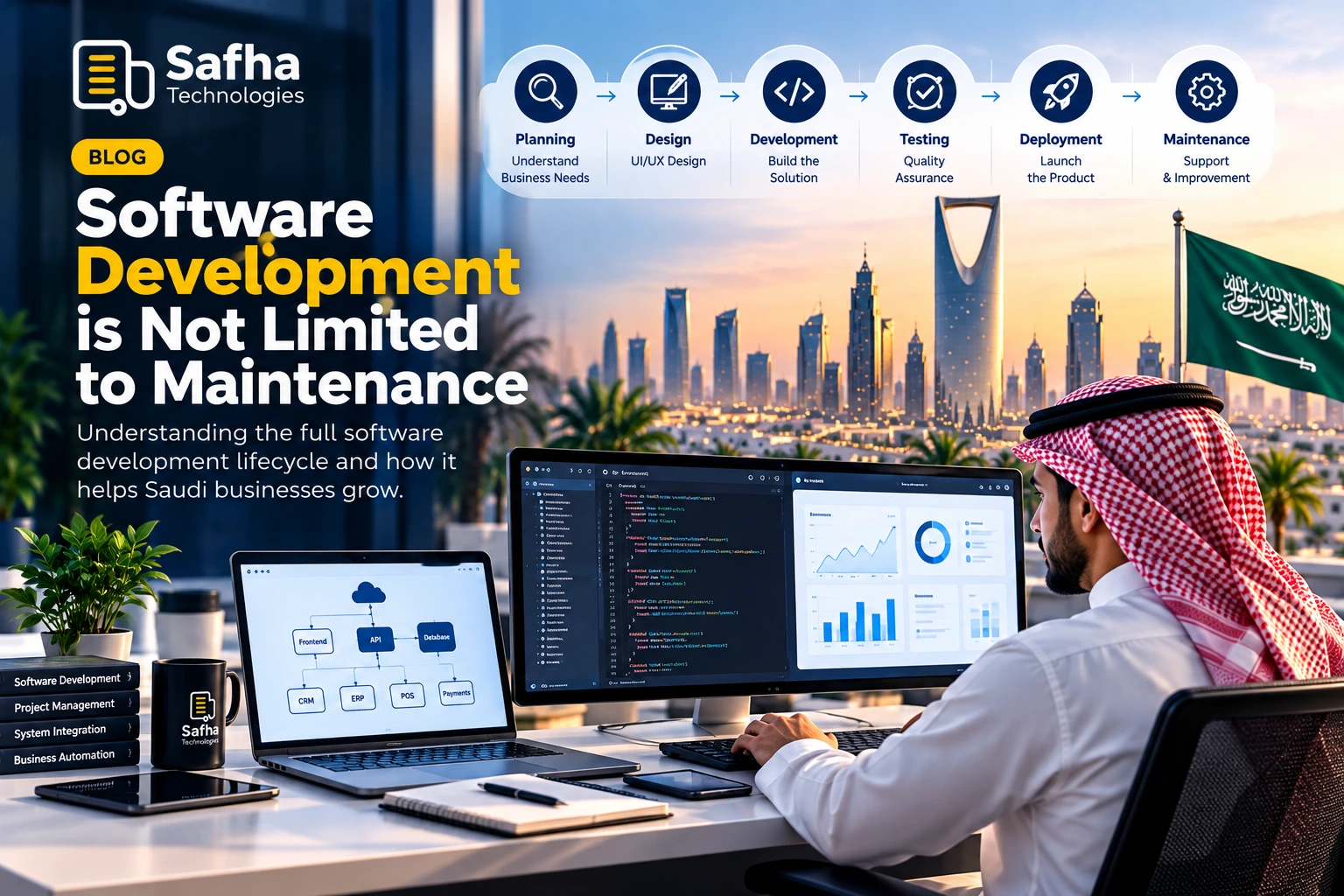
Modern businesses rely on software for sales, customer management, operations, finance, communication, automation, and digital services. However, there is a common misconception that software development is limited to maintenance.
In reality, software development covers the complete lifecycle of a digital product — from understanding the business requirement and planning the project to designing, developing, testing, launching, integrating, and continuously improving the software.
For businesses in Saudi Arabia, including Riyadh, Jeddah, Dammam, Al Khobar, and the Eastern Province, choosing the right software development partner can help turn business requirements into practical digital solutions.
Safha Technologies provides custom software development services covering web applications, mobile applications, business automation, artificial intelligence solutions, CRM, POS, Odoo ERP, and other digital platforms.
Key Takeaways
- Software development is much broader than software maintenance.
- Development can include planning, design, programming, testing, deployment, integration, and ongoing improvement.
- Software maintenance is only one stage of the overall software lifecycle.
- Custom software can be designed around a company’s actual business processes.
- Saudi businesses can use custom software to improve operations, customer experiences, automation, and digital services.
- A reliable development partner should understand both technical requirements and business objectives.
What Is Software Development?
Software development is the process of creating, improving, and delivering software applications and digital systems.
Depending on the project, software development can involve:
- Business analysis
- Project planning
- Software architecture
- UI/UX design
- Web development
- Mobile app development
- Backend development
- Database development
- API integration
- Artificial intelligence
- Automation
- Testing
- Deployment
- Security
- Maintenance
- Continuous improvements
The goal is not simply to write code. A successful software project should solve a specific business problem and provide a practical experience for its users.
Is Software Development Limited to Maintenance?
No. Software development is not limited to maintenance.
Software maintenance generally happens after a product has already been developed and launched. It may involve fixing bugs, improving performance, updating dependencies, addressing security issues, or making smaller changes.
Software development, however, can begin before the first line of code is written.
For example, if a Saudi company wants to build a customer management platform, the development process could include:
- Understanding the business requirements.
- Defining user roles and workflows.
- Planning the software architecture.
- Designing the user experience.
- Developing the application.
- Connecting databases and APIs.
- Testing the system.
- Launching the platform.
- Monitoring performance.
- Adding new features over time.
Maintenance is therefore one part of software development and the software lifecycle, not the entire process.
What Are Software Development Services?
Professional software development services can cover the complete process of building and improving digital products.
Custom Software Development
Custom software is designed around the specific requirements of a company.
It can be useful when existing software does not properly support the company’s processes.
Examples include:
- Business management systems
- Customer portals
- Internal management platforms
- Booking systems
- Inventory systems
- Employee platforms
- Document management systems
- Industry-specific applications
Web Application Development
Web applications allow users to access business systems through a browser.
Examples include:
- Customer portals
- SaaS platforms
- Business dashboards
- E-commerce platforms
- Internal company systems
Mobile App Development
Mobile applications can help businesses provide services directly through smartphones.
They can include:
- Customer applications
- Delivery applications
- Booking applications
- Employee applications
- E-commerce applications
- Service applications
UI/UX Design
A software product needs more than technical functionality. Users should be able to understand and navigate it easily.
UI/UX design focuses on:
- User journeys
- Navigation
- Interface design
- Usability
- Mobile responsiveness
- Accessibility
- Overall user experience
API and System Integration
Businesses often use several systems at the same time.
Software development can connect these systems through APIs and integrations.
For example, a business platform may connect with:
- CRM
- ERP
- POS
- Payment systems
- E-commerce platforms
- Accounting software
- External services
Types of Software Maintenance
Although software development goes beyond maintenance, maintenance remains an important part of the software lifecycle.
There are several common types of software maintenance.
Corrective Maintenance
Fixing errors, bugs, and unexpected problems discovered after deployment.
Adaptive Maintenance
Updating software so that it continues to work with changes in operating systems, platforms, regulations, or external services.
Perfective Maintenance
Improving existing functionality based on user feedback or changing business requirements.
Preventive Maintenance
Making technical improvements that help reduce future problems and improve maintainability.
Effective maintenance can help extend the useful life of a software product, but it should not be confused with the complete development process.
Software Project Management
Good software development requires more than technical skills.
Software project management helps organize the project from planning through delivery.
A typical project may include:
Requirement Analysis
Understanding what the business needs and what the software should accomplish.
Project Planning
Defining the scope, priorities, milestones, resources, and expected deliverables.
Design
Creating the software architecture and user interface before development begins.
Development
Building the required frontend, backend, database, APIs, and integrations.
Quality Assurance
Testing the software to identify functional, usability, performance, compatibility, and security issues.
Deployment
Moving the completed software into the appropriate production environment.
Maintenance and Improvement
Monitoring the product and making updates based on business and user requirements.
Benefits of Custom Software Development for Businesses
Custom software can provide several advantages when it is designed around a genuine business requirement.
Better Business Processes
Software can be designed around the way a company actually operates rather than forcing employees to work around a generic system.
Automation
Repetitive tasks can potentially be automated, reducing manual work and improving operational consistency.
Centralized Information
Different business processes can be connected through one platform, depending on the project requirements.
Better Customer Experience
Customer-facing applications and portals can make it easier for customers to access services, submit requests, track orders, or manage their accounts.
Integration
Custom software can connect different business systems and allow information to move between them.
Scalability
A properly planned architecture can support future users, features, data, and integrations.
Software Development for Businesses in Saudi Arabia
Saudi businesses across Riyadh, Jeddah, Dammam, Al Khobar, and the Eastern Province operate across a wide range of industries and digital requirements.
Custom software can support businesses in areas such as:
- Retail
- Restaurants
- Healthcare
- Education
- Logistics
- Real estate
- Manufacturing
- Professional services
- E-commerce
- Enterprise operations
Depending on the project, Saudi businesses may require:
- Arabic and English interfaces
- Right-to-left support
- Mobile-friendly experiences
- Local payment integrations
- Business system integrations
- Role-based access
- Automated workflows
- Customer portals
- Management dashboards
- Industry-specific functionality
The exact requirements depend on the business model, industry, users, and type of information being processed.
How Does the Software Development Process Work?
A structured development process can help reduce unnecessary complexity and keep the project aligned with business objectives.
1. Understand the Business
The development team identifies the problem, target users, business processes, and expected outcomes.
2. Define Requirements
The required features, user roles, workflows, integrations, and technical requirements are documented.
3. Plan the Solution
The team determines the architecture, technology stack, development approach, and project priorities.
4. Design the Experience
UI/UX designs and user journeys are created before full development begins.
5. Develop the Software
The development team builds the frontend, backend, database, APIs, and required integrations.
6. Test the Product
The software is tested for functionality, performance, compatibility, usability, and security.
7. Launch
The application is deployed to the appropriate environment and made available to users.
8. Maintain and Improve
After launch, the product can be monitored, maintained, and continuously improved according to business needs.
How to Choose a Software Development Company in Saudi Arabia?
When choosing a software development company, businesses should look beyond the programming language or technology being used.
Technical Experience
Check whether the team has experience with the technologies, databases, APIs, cloud infrastructure, and integrations required for your project.
Understanding of Your Business
A development company should understand the problem the software needs to solve, not simply build a list of features.
UI/UX Capability
The product should be easy for its intended users to understand and navigate.
Scalability
Discuss how the system can support future users, data, integrations, and functionality.
Security
Ask how user accounts, permissions, data, authentication, backups, and system access will be protected.
Post-Launch Support
Clarify how maintenance, bug fixes, updates, monitoring, and future development will be handled.
Safha Technologies’ Approach to Software Development
Safha Technologies combines software development, UI/UX design, business automation, system integration, and digital solutions to help businesses build technology around their actual requirements.
Depending on the project, services can include:
- Custom software development
- Web application development
- Mobile app development
- UI/UX design
- CRM solutions
- POS solutions
- Odoo ERP
- Artificial intelligence solutions
- Business automation
- API integration
- Document management solutions
- Employee and attendance solutions
The focus is on understanding the business requirements first, then selecting the appropriate technology and development approach.
Conclusion
Software development is not limited to maintenance.
Maintenance is an important part of the software lifecycle, but professional software development can cover everything from business analysis and planning to UI/UX design, programming, testing, deployment, integration, maintenance, and continuous improvement.
For businesses in Saudi Arabia, custom software can help digitize processes, automate repetitive tasks, integrate different systems, and create better experiences for employees and customers.
If your company is planning a new digital product or wants to improve an existing system, the right development approach should begin with your business requirements rather than technology alone.
Build Your Digital Solution with Safha Technologies
Safha Technologies helps businesses in Saudi Arabia turn business requirements into custom digital solutions.
Discuss your project requirements and explore the right technology approach for your business.